

UGC video production gives brands a way to create short-form video that feels closer to the content people naturally encounter in social feeds. Instead of relying only on studio advertising, brands can work with creators, customers, employees, or other contributors to produce product demonstrations, testimonials, tutorials, problem-solution videos, unboxings, and other creator-led formats.
However, producing useful UGC is more complicated than asking someone to hold a product in front of a phone camera. The strongest programs connect business objectives, creator selection, content angles, briefs, filming standards, editing, usage rights, compliance, and performance testing into one repeatable workflow.
This guide explains how UGC video production works, which formats brands can test, how to build an efficient production process, and how to judge creative results without assuming that one viral video is the goal.
What Is UGC Video Production?
UGC video production is the process of creating video content designed around the language, presentation, and viewing habits of user-generated or creator-led social content.
The term UGC originally refers to content created voluntarily by users or customers rather than commissioned by a brand. In modern marketing, however, brands also use terms such as UGC creator, UGC-style video, or creator-generated content for videos that are intentionally commissioned but designed to feel natural within social environments.
That distinction matters. A genuine customer video that already exists online has a different sourcing, permission, and compensation process from a video a brand pays a creator to produce from a brief.
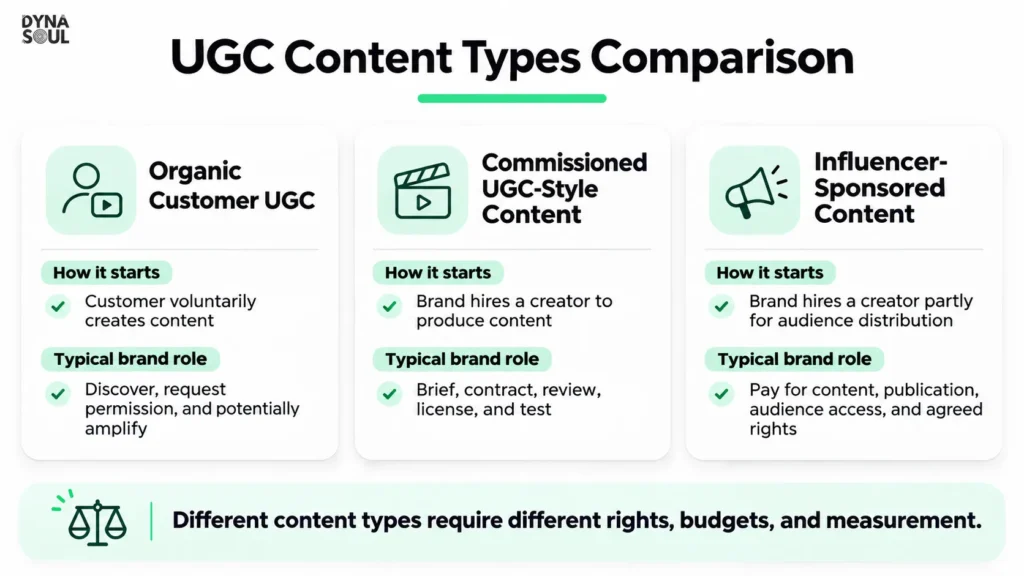
| Content Type | How It Starts | Typical Brand Role |
|---|---|---|
| Organic customer UGC | A customer voluntarily creates content | Discover, request permission, and potentially amplify |
| Commissioned UGC-style content | A brand hires a creator to produce content | Brief, contract, review, license, and test |
| Influencer-sponsored content | A brand hires a creator partly for audience distribution | Pay for content, publication, audience access, and agreed rights |
| Brand-native creator content | A brand produces creator-style content internally | Control production while maintaining a native social format |
All four can be useful. The important thing is to identify which type the campaign is actually using because the budget, rights, disclosure requirements, and measurement approach can be different.
Why Brands Use UGC-Style Video
Short-form social platforms have changed what advertising creative looks like. A polished commercial can still be valuable, but it is no longer the only way to communicate quality or credibility.
Creator-led video can help brands:
- Show products in realistic situations
- Explain features through demonstrations
- Address common customer objections
- Create multiple creative concepts relatively efficiently
- Test different hooks and messages
- Build a larger library of short-form assets
- Create variations for paid social campaigns
- Present products through different personalities and use cases
Current TikTok creative guidance emphasizes content that feels native, human, vertical, and testable rather than simply reproducing traditional advertising in a mobile feed.
The objective should not be to make every video look deliberately low quality. Natural-looking content still needs clear audio, understandable visuals, useful storytelling, and a coherent message.
UGC Video Production Is Not the Same as Influencer Marketing
UGC production and influencer marketing often overlap, but they solve different problems.
In influencer marketing, part of what the brand purchases is access to the creator’s audience. The creator usually publishes the content on their own channel as part of the agreement.
In commissioned UGC production, the brand may primarily be purchasing the creator’s ability to make useful content. The creator may not publish it at all. Instead, the brand can use the licensed assets on its own social channels, product pages, or advertising campaigns according to the agreed rights.
This difference affects creator selection. A UGC creator does not necessarily need a large following. Camera presence, product understanding, storytelling, production reliability, and the ability to communicate naturally may matter more.
UGC Video Formats Brands Can Produce
One of the main advantages of UGC video production is the number of creative angles that can be produced from the same product. Instead of making ten nearly identical videos, brands can build a library around distinct customer questions and motivations.
1. Testimonial or Experience Video
A creator explains their experience with the product in a direct-to-camera format. This works best when the content sounds specific rather than generic.
Useful testimonial prompts can include:
- What problem were you trying to solve?
- Why did you try this product?
- What did you notice during use?
- Who would you recommend it to?
- What feature mattered most?
Claims should reflect genuine experiences and should not exaggerate outcomes that the brand cannot substantiate.
2. Product Demonstration
Demonstration videos show the product being used rather than merely describing it. They can be especially useful when the value proposition becomes clearer through movement, texture, setup, interface use, or a visible process.
A good demonstration usually answers three questions quickly: what is it, how does it work, and why should the viewer care?
3. Problem-Solution Video
This format begins with a recognizable frustration or need and introduces the product as one possible solution.
The problem should feel specific enough to be relatable. Broad openings such as “Do you want to improve your life?” provide much less information than a concrete situation the target customer recognizes immediately.
4. Tutorial or How-To
Tutorials teach the viewer how to use the product or achieve a result. They can combine education with product demonstration, making them useful for products that need explanation before the value becomes obvious.
Brands can create beginner tutorials, feature-specific explainers, setup videos, routines, recipes, workflows, or troubleshooting content.
5. Unboxing and First Impression
Unboxing content shows the product experience from arrival through first use. It can highlight packaging, included components, setup, texture, design, or other details customers may want to understand before purchasing.
The format works best when there is genuinely something useful to reveal rather than when the creator performs an artificial reaction.
6. Objection-Handling Video
Customers often hesitate for recurring reasons: price, complexity, size, compatibility, delivery, ingredients, setup, durability, or uncertainty about whether the product is right for them.
A UGC video can focus on one objection at a time. This gives paid media teams different assets for different customer concerns instead of forcing one advertisement to answer everything.
7. Comparison or Decision Video
A creator can explain why they chose one product type, feature set, workflow, or solution over another. Brands should be careful with objective competitor claims and ensure factual comparisons can be supported.
8. Lifestyle or Day-in-the-Life Video
This format integrates the product into a realistic routine rather than building the entire video around a formal product pitch.
The value comes from context. Viewers can see when, where, and why the product fits into someone’s day.
9. FAQ Video
Frequently asked questions from customer service, comments, search queries, reviews, or sales teams can become individual creator videos.
This approach creates useful content while giving the production team a reliable source of ideas grounded in actual customer uncertainty.
Start the UGC Production Workflow With an Objective
A common production mistake is beginning with the instruction “We need more UGC.” That describes a format, not a business objective.
First decide what the content needs to accomplish.
Possible objectives include:
- Generate paid-social creative
- Increase product understanding
- Support a new product launch
- Address purchase objections
- Create social proof
- Produce assets for organic social channels
- Create product-page or landing-page video
- Test new positioning or messages
The objective determines what creators should produce and how success should be measured.
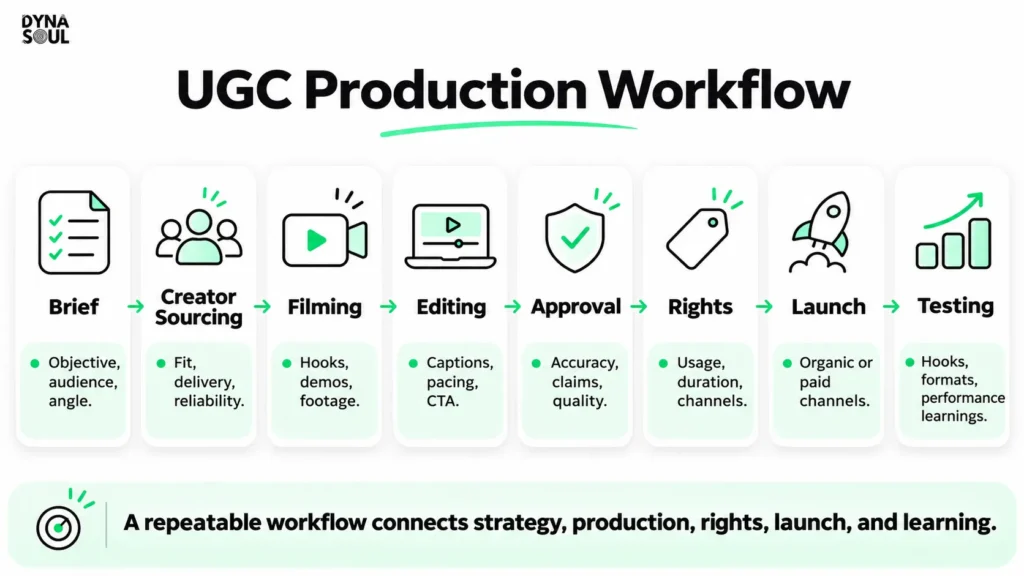
A Practical UGC Video Production Workflow
Step 1: Define the Audience and Creative Problem
Start with the customer rather than the creator. Identify what the audience wants, what prevents action, what they misunderstand, and what evidence might help them make a decision.
This creates stronger creative angles than simply asking creators to “talk about the benefits.”
Step 2: Build a Creative Angle Library
List different messages that deserve testing. These might include:
- Customer problems
- Product benefits
- Specific features
- Objections
- Use cases
- Product demonstrations
- Comparisons
- Customer questions
- Offers or bundles
- Different audience segments
Separating angles helps the team produce intentionally different videos instead of repeating the same concept with new creators.
Step 3: Select Creators for the Content Requirement
For UGC production, creator selection should focus heavily on production fit.
Review:
- On-camera delivery
- Voice and speaking style
- Visual environment
- Editing ability
- Product-category familiarity
- Language and accent where relevant
- Reliability and turnaround time
- Ability to follow required claims and instructions
- Previous examples of similar formats
A diverse creator pool can also help brands test different personalities, customer profiles, use cases, and presentation styles.
Step 4: Define Deliverables and Usage Rights
Before production starts, specify exactly what the brand is purchasing.
The agreement can define:
- Number of videos
- Expected duration
- Aspect ratio and orientation
- Whether raw footage is included
- Number of revisions
- Organic usage rights
- Paid advertising rights
- Usage duration
- Platforms covered
- Territories where relevant
- Whether editing or derivative versions are permitted
Getting these terms clear before filming reduces disputes and prevents the brand from discovering later that a winning video cannot be used in the intended channel.
Step 5: Write a Useful Creator Brief
A strong UGC brief provides structure without scripting every movement and sentence.
Include:
- Campaign objective
- Target audience
- Product background
- Main creative angle
- Key product facts
- Claims that cannot be made
- Required visual demonstrations
- Potential hooks
- Call to action where relevant
- Technical requirements
- Disclosure requirements where applicable
- Reference examples
- Deadline and approval process
A brief should explain what the creator needs to communicate while leaving room for natural language. Over-scripted UGC can lose the conversational quality the format is intended to provide.
How to Structure a UGC Video
There is no single formula that every successful video follows, but a useful starting structure is:
Hook → context or problem → product demonstration or proof → benefit → next step
The Hook
The opening needs to give the viewer a reason to continue. Hooks can use a problem, question, surprising observation, product demonstration, objection, or visual change.
Create several hook options for strong concepts. Changing only the first few seconds can create meaningfully different creative tests without requiring an entirely new production.
The Body
The body should deliver on the opening rather than changing topics. Show the product, demonstrate the relevant feature, explain the experience, or provide the evidence the hook promised.
The Close
The final section should make the next step clear when a call to action is appropriate. It does not always need to sound aggressively promotional. The best wording depends on the platform, campaign stage, and customer intent.
Production Quality: Native Does Not Mean Careless
UGC-style content often looks less polished than a traditional studio commercial, but intentionally natural is different from technically poor.
Current TikTok commercial-content guidance identifies image quality, sound quality, coherent content, authentic experience, and effective creative execution as important quality dimensions.
Brands should generally look for:
- Clear, intelligible audio
- Adequate lighting
- Stable or intentionally controlled camera movement
- A clean enough background to understand the subject
- Readable on-screen text
- Correct product representation
- Vertical framing when producing for vertical social placements
- Enough resolution for editing and adaptation
- Space for interface elements and captions
A slightly imperfect room or handheld camera can feel natural. Distorted audio, unreadable text, incorrect product information, or poor framing usually does not add authenticity.
Record More Than the Final Script
One efficient production practice is to collect modular footage instead of requesting only one finished video.
Ask for multiple:
- Opening hooks
- Product close-ups
- Demonstration clips
- Reactions
- Voiceover lines
- Calls to action
- Lifestyle shots
- Alternative endings
When rights allow, these pieces can give editors more flexibility to create variations without reshooting the entire concept.
This approach is particularly useful for paid media because the team can test combinations of hooks, bodies, proof points, and endings.
Editing UGC Videos for Social Platforms
The edit should support clarity and pacing rather than making every video visually complicated.
Common editing elements include:
- Removing pauses and unnecessary setup
- Jump cuts where appropriate
- Captions or subtitles
- On-screen benefit or feature text
- Product close-ups
- B-roll over voiceover
- Simple zooms or crops
- Music or sound where licensing permits
- Clear calls to action
TikTok’s current creative guidance recommends mobile-first vertical production, captions, human storytelling, multiple versions, and ongoing creative testing. The exact execution should still reflect the brand and platform rather than copying every current editing trend.
Disclosure and Commercial Content Requirements
Commissioned creator content can create disclosure obligations depending on where and how the content is published.
In the United States, FTC guidance says material relationships between an endorser and a brand should be clearly disclosed. A material connection can include payment, free products, discounts, employment, or other relationships that could affect how viewers evaluate the endorsement.
If a creator publishes sponsored content to their own audience, disclosure requirements should be included in the brief and approval workflow rather than handled as an afterthought.
TikTok currently requires creators promoting a brand, product, or service to use its commercial-content disclosure setting for applicable posts.
Requirements vary by jurisdiction and platform, so brands should confirm the rules that apply to each campaign rather than assuming one disclosure process applies globally.
Usage Rights Matter in UGC Video Production
Brands should not assume that paying a creator for production automatically gives them unlimited ownership or unlimited advertising rights.
A UGC agreement should clarify:
- Who owns the finished asset
- What license the brand receives
- Whether the content can be used organically
- Whether paid advertising is allowed
- How long usage lasts
- Which channels are covered
- Whether the content can be edited
- Whether raw footage can be reused
- Whether creator identity can be used in advertising
Rights should match the intended distribution plan. A video produced only for an organic social post requires a different commercial package from a video that will be tested across paid advertising, websites, marketplaces, and other channels.
How to Test UGC Creative
The purpose of creative testing is not to declare one video a winner and stop. It is to learn which combinations of message, creator, hook, format, and proof deserve further production.
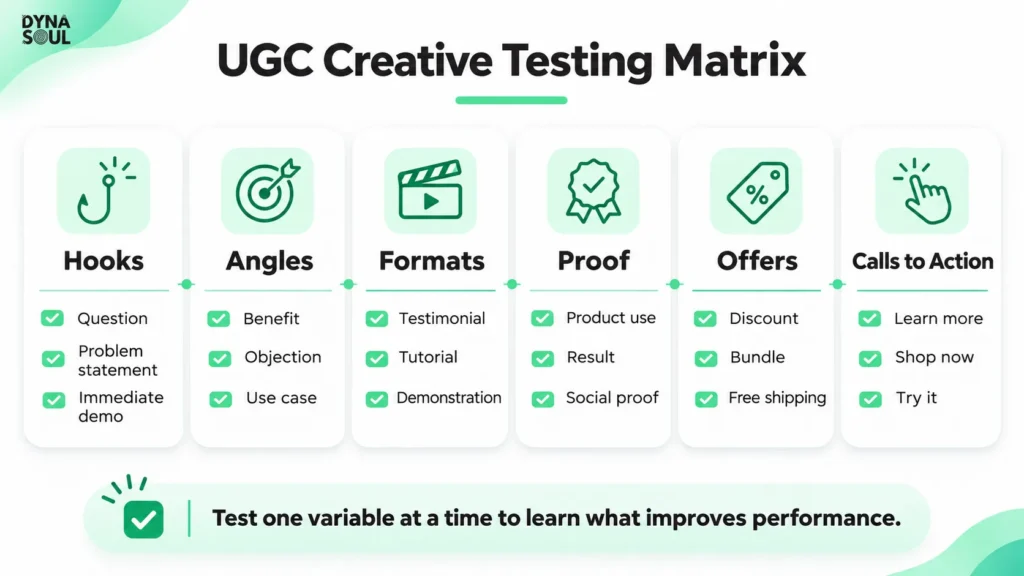
A test matrix can include:
| Variable | Example Tests |
|---|---|
| Hook | Question vs problem statement vs immediate demonstration |
| Creator | Different personalities, customer profiles, or delivery styles |
| Angle | Feature vs benefit vs objection vs use case |
| Format | Testimonial vs tutorial vs demonstration |
| Proof | Product use vs explanation vs social proof |
| CTA | Learn more vs product discovery vs direct purchase language |
Try to understand what changed between versions. If the creator, hook, message, offer, edit, and landing page all change simultaneously, the team may see a performance difference without learning why it happened.
How to Measure UGC Video Results
The right metrics depend on where and why the content is being used.
Attention Metrics
Watch time, completion behavior, early viewer retention, and other video-consumption metrics can help identify whether the creative holds attention.
Engagement Metrics
Comments, shares, saves, reactions, and other interactions can provide information about how viewers respond to the content, especially for organic use.
Traffic Metrics
Click-through rate and landing-page sessions can help evaluate whether the creative motivates people to continue beyond the video.
Conversion Metrics
For performance campaigns, conversion rate, cost per acquisition, revenue, and other business outcomes may matter more than engagement alone.
Creative Learning
Brands should also evaluate what each production batch teaches them. A concept that performs poorly can still provide valuable information if it clearly tests a customer problem, message, creator type, or format.
The goal is to build a creative system where each round of production improves the next brief.
Do Not Judge UGC Only by Virality
A video does not need millions of organic views to be useful.
A relatively simple creator video may become valuable because it explains a product clearly, reduces an objection, produces strong paid-ad conversion, provides reusable footage, or reveals a message worth developing further.
Virality is one possible outcome. It should not automatically be the production KPI.
A Repeatable UGC Production System
Brands can use the following process to turn UGC video production into an ongoing creative operation:
- Define the business and creative objective.
- Identify the audience problem or motivation.
- Build several distinct creative angles.
- Select creators based on production and audience fit.
- Define deliverables, compensation, deadlines, and usage rights.
- Create briefs that establish requirements without over-scripting.
- Produce multiple hooks and reusable supporting footage.
- Review product accuracy, claims, technical quality, and disclosure requirements.
- Edit platform-appropriate versions.
- Launch the creative in the intended organic or paid channels.
- Measure attention, engagement, traffic, and conversion based on the objective.
- Document what worked and feed those insights into the next production cycle.
The final step is what separates a content order from a creative system. Each batch should give the team more information about which customers, messages, creators, hooks, and formats deserve further investment.
Common UGC Video Production Mistakes
Asking for “Authentic UGC” Without a Clear Objective
Authenticity is not a production brief. Creators need enough context to understand the audience, product, message, and intended use.
Over-Scripting Every Word
A rigid script can make creator-led content sound unnatural. Give creators the facts and structure they need while allowing them to communicate in a believable voice.
Under-Briefing the Creator
The opposite problem is giving almost no direction. Creators cannot reliably guess which features, claims, framing, or customer objections matter most to the brand.
Producing One Version of Every Concept
One hook and one edit provide limited learning. Capture variations so strong concepts can be developed without rebuilding the entire production.
Confusing Low Production Quality With Authenticity
Natural-looking content can still have clear sound, strong lighting, readable captions, and intentional storytelling.
Ignoring Usage Rights
A useful video can become difficult to scale if the brand does not have the rights required for paid advertising or broader reuse.
Optimizing Only for Views
Views can indicate distribution or attention, but they do not automatically show whether the creative influenced traffic, conversions, or business results.
FAQ
What is UGC video production?
UGC video production is the process of creating video designed around user-generated or creator-led social formats. It can involve genuine customer content or commissioned creators producing testimonials, demonstrations, tutorials, problem-solution videos, and other native-looking short-form assets.
What is the difference between UGC and influencer content?
Influencer campaigns usually pay partly for access to the creator’s audience and typically involve publication on the creator’s own account. Commissioned UGC production may focus primarily on creating assets for the brand to use, so a large creator following is not always necessary.
What are the best UGC video formats for brands?
Useful formats include testimonials, product demonstrations, tutorials, problem-solution videos, unboxings, objection handling, lifestyle content, comparisons, and FAQ videos. The best format depends on the audience question and campaign objective.
Should UGC videos be scripted?
Brands should usually provide structure, key facts, required claims, prohibited claims, and creative direction without forcing every creator to use exactly the same wording. Some regulated or highly technical content may require tighter scripting and review.
Can brands use UGC videos in paid advertising?
They can when the necessary rights or licenses have been secured. The agreement should specify whether paid use is permitted, how long the license lasts, which channels are included, and whether the brand can edit or create derivative versions.
How do brands measure UGC video performance?
Measurement depends on the objective. Brands can evaluate watch behavior, engagement, clicks, conversion rate, acquisition cost, revenue, or other business outcomes. They should also record creative learning so results improve future briefs and production decisions.
Final Thoughts on UGC Video Production
Effective UGC video production is not simply about making advertisements look less polished. It is about building content around recognizable customer situations, credible people, clear product communication, and a repeatable testing process.
The strongest programs connect strategy to production. Brands define the customer problem, develop distinct creative angles, choose creators for the job, establish rights before filming, capture flexible footage, and use performance data to determine what should be produced next.
If your brand needs support turning creator concepts into a repeatable UGC production and testing workflow, explore Dyna Soul Solutions.


