

A social media marketing strategy gives a growing brand a clear system for deciding where to show up, what to publish, how to engage, and how social activity should contribute to broader business goals. Without that structure, social media can easily become a calendar of disconnected posts that consume time without creating useful learning or measurable progress.
The strongest strategies do more than chase reach or follower growth. They connect audience insight, platform roles, content pillars, creative production, community management, paid amplification, and measurement. That gives the team a way to understand not only what performed, but why it performed and what should happen next.
This guide explains how to build a social media marketing strategy for a growing brand, from choosing platforms and planning content to measuring results and creating a repeatable operating rhythm.
What Is a Social Media Marketing Strategy?
A social media marketing strategy is a plan for using social platforms to achieve defined marketing and business objectives. It explains who the brand wants to reach, which platforms matter, what type of content the brand will create, how often the team will publish, how the community will be managed, and how performance will be evaluated.
A strategy should also clarify what social media is not responsible for. Not every platform needs to generate direct sales, and not every post needs to go viral. Some activity may build awareness, some may educate prospective customers, some may support retention, and some may drive traffic or conversion.
The important step is to give each activity a clear role instead of evaluating every post against the same metric.
Start With Business Goals, Not a Posting Calendar
Many brands begin social planning by asking what to post next week. A better starting point is what the business needs social media to influence.
Possible goals include:
- Increase brand awareness in a defined audience
- Build familiarity before a product launch
- Educate prospective customers about a complex product
- Generate qualified website traffic
- Support lead generation or e-commerce sales
- Create a stronger customer community
- Improve retention through education and support
- Generate creator or user-generated content
- Develop executive or brand thought leadership
- Learn which messages resonate with the market
The goal influences everything that follows. A brand trying to build category awareness needs a different content mix from a company using social media primarily to support lead generation. A product launch may require concentrated education and proof, while an established brand may need stronger community and retention content.
Choose One Primary Goal for Each Major Initiative
Social media can contribute to several objectives at once, but individual campaigns and content programs are easier to evaluate when they have a primary purpose.
For example, a video series designed to explain a difficult product concept may be evaluated using watch behavior, saves, comments, and downstream site visits. A product-launch campaign may place more emphasis on qualified traffic, sign-ups, purchases, or another conversion event.
Clear objectives reduce the temptation to judge every activity by follower count or likes.
Understand the Audience Before Choosing Platforms
A platform should be selected because it fits the audience and the job the brand needs to accomplish, not because it is popular or because a competitor is active there.
Audience research should go beyond basic demographics. Useful questions include:
- What problems or goals bring the audience into the category?
- What questions do they ask before buying?
- What objections slow down a decision?
- Which creators, communities, experts, or brands already influence them?
- What content formats do they naturally consume?
- Which platforms do they use for entertainment, discovery, research, professional learning, or purchase decisions?
- What language, examples, and cultural references feel natural to them?
Customer service conversations, sales calls, reviews, social comments, search queries, creator content, and community discussions can all reveal useful themes.
Choose Social Platforms by Strategic Role
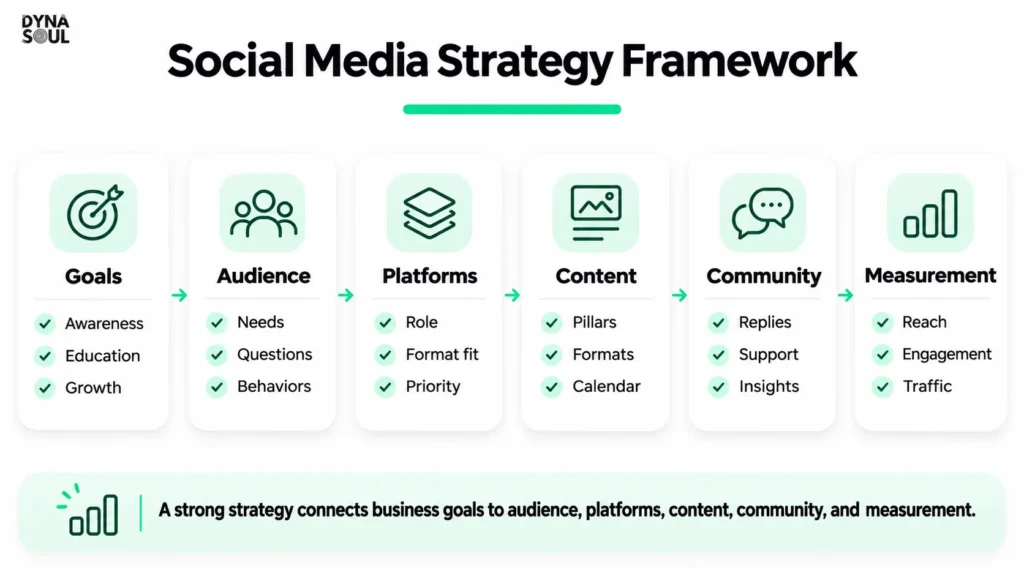
Growing brands do not need to be equally active everywhere. Each additional platform creates work: content adaptation, publishing, moderation, analytics, community engagement, and creative production.
A useful platform decision asks two questions: is the target audience meaningfully present, and can the brand consistently create content that fits the environment?
| Platform Type | Potential Strategic Role | Content Strengths |
|---|---|---|
| Short-form video platforms | Discovery, entertainment, education, product demonstration | Vertical video, creator-led content, demonstrations, storytelling |
| Visual social platforms | Brand building, product discovery, community, social proof | Images, Reels, Stories, carousels, creator content |
| Professional networks | Thought leadership, B2B education, employer brand, lead nurturing | Expert posts, documents, video, case studies, commentary |
| Long-form video platforms | Education, search-driven discovery, demonstrations, deeper storytelling | Tutorials, reviews, explainers, interviews, long-form video |
| Community-oriented platforms | Discussion, support, feedback, retention, niche participation | Questions, conversations, community posts, live interaction |
The same brand can use several platforms, but the content should not be copied mechanically. The core idea may stay consistent while the format, pacing, tone, and depth change for the environment.
Start Narrow Enough to Learn
A smaller team may learn more from operating two priority platforms well than from maintaining five accounts with inconsistent content and limited community engagement.
Expansion makes more sense when the existing workflow can support another channel without weakening the quality or consistency of the current ones.
Build Content Pillars Around Audience Needs
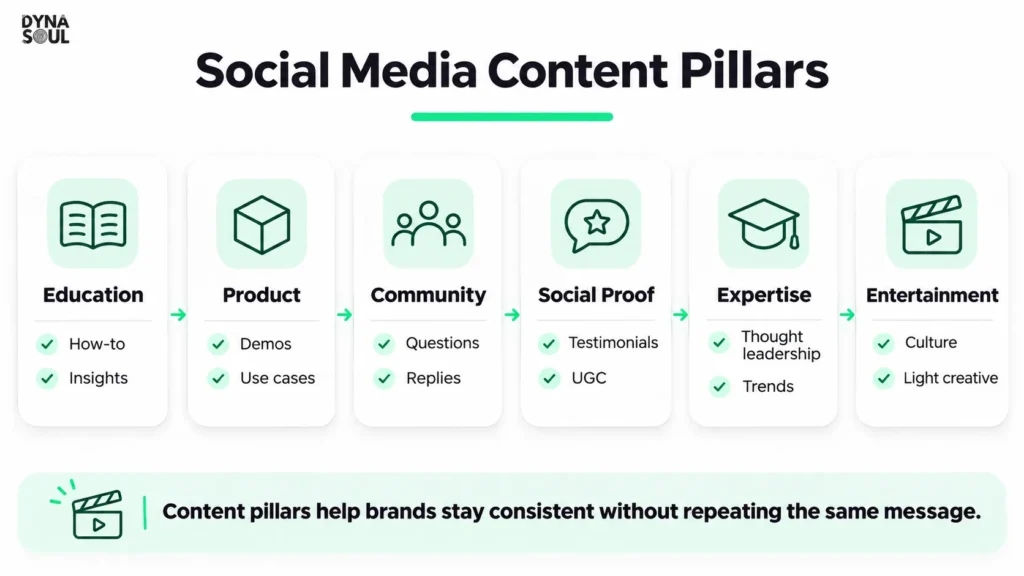
Content pillars are recurring themes that help a brand produce consistently without repeating the same message. They should connect what the audience cares about with what the brand has a credible reason to discuss.
A useful set of pillars might include:
- Education and how-to content
- Product use cases and demonstrations
- Customer stories and social proof
- Industry insight or thought leadership
- Behind-the-scenes content
- Founder, employee, or expert perspectives
- Community questions and responses
- Entertainment or culturally relevant content
- Product updates and launches
The exact mix depends on the brand. A B2B software company may rely heavily on expertise, customer problems, and industry insight. A consumer brand may need more demonstrations, lifestyle context, creator content, and product education.
Do Not Turn Every Pillar Into a Sales Pitch
If every post immediately asks the audience to buy, social content becomes predictable. Useful brands give people reasons to follow even when they are not ready to purchase.
Educational content, useful opinions, practical demonstrations, entertaining ideas, customer stories, and community participation can build familiarity that makes later commercial content more effective.
Create Formats That Fit the Idea
Content strategy should define both what the brand talks about and how those ideas are expressed.
Common formats include:
- Short-form video
- Static images
- Carousels or document posts
- Stories
- Long-form video
- Livestreams
- Text-led posts
- Polls and questions
- Creator collaborations
- User-generated content
- Customer testimonials
- Behind-the-scenes content
A format should support the message rather than being selected only because it is currently popular. A complex explanation may work better as a carousel, document, or longer video. A product transformation may need visual demonstration. A timely opinion may need a simple text or talking-head post.
Build a Content Calendar Without Making It Rigid
A content calendar creates operational discipline. It helps the team balance themes, plan production, coordinate launches, and avoid last-minute posting.
A useful calendar can track:
- Publication date
- Platform
- Content pillar
- Format
- Audience segment
- Campaign or business objective
- Creative owner
- Approval status
- Call to action
- Tracking link where relevant
- Performance notes after publication
The calendar should still leave room for timely content. Customer questions, industry news, creator opportunities, community conversations, and cultural moments do not always appear weeks in advance.
Choose a Sustainable Publishing Cadence
There is no universal posting frequency that works for every brand. The right cadence depends on platform, content quality, production capacity, audience behavior, and the amount of useful material the brand can consistently produce.
A sustainable schedule that supports learning is more useful than an aggressive schedule that collapses after a few weeks.
Build a Social Content Production System
Growing brands often struggle with social media because every post is treated as a separate creative project. A production system reduces that friction.
A practical workflow can look like this:
- Collect audience questions, insights, trends, and business priorities.
- Turn them into content concepts.
- Group concepts into production batches.
- Create or capture the core assets.
- Edit platform-specific versions.
- Review brand, factual, legal, and product accuracy.
- Schedule or publish.
- Engage with audience responses.
- Review performance and capture learning.
- Feed the learning into the next content cycle.
Batch production can be particularly useful for video. One filming session may produce several short clips, product demonstrations, interviews, customer questions, or behind-the-scenes assets that can be edited into multiple pieces of content.
Use Creators, Customers, and Employees Strategically
Brand-owned social accounts do not need to rely only on polished company content.
Creators can bring different storytelling styles and cultural relevance. Customers can provide experiences and social proof when permissions and claims are handled appropriately. Employees and subject-matter experts can make the brand more human and give audiences access to knowledge that a corporate account alone may struggle to communicate.
The important question is what role each voice plays.
For example:
- A creator may demonstrate a product in a familiar social format.
- A customer may explain a real use case.
- A founder may discuss the reason behind a company decision.
- An expert may answer technical questions.
- An employee may show how the product is made or supported.
A strong social media marketing strategy combines these voices intentionally instead of relying on one content source for everything.
Community Management Is Part of the Strategy
Publishing is only one half of social media. Comments, questions, mentions, direct messages, reactions, and community discussions can provide both relationship value and market insight.
Community management can include:
- Replying to questions
- Responding to customer feedback
- Escalating service issues
- Joining relevant conversations
- Recognizing useful customer content
- Moderating harmful or inappropriate comments
- Identifying repeated objections or misunderstandings
- Recording content ideas from audience questions
Responses should reflect the brand’s voice while giving community managers enough flexibility to sound human. A library of approved answers can help with common questions, but copying the same corporate response into every conversation can weaken trust.
Turn Community Feedback Into Content
Repeated questions are valuable creative inputs. If people regularly ask how a product works, whether it fits a certain use case, how it compares with an alternative, or what happens after purchase, those questions can become future posts.
This creates a feedback loop where community management informs content strategy instead of operating as a separate function.
Connect Organic Social and Paid Media
Organic and paid social have different strengths, but they can support each other.
Organic activity can help brands test messages, understand community response, develop recognizable content formats, and build a library of creative ideas. Paid media can extend selected messages to larger or more specific audiences when the objective and economics justify it.
A post that performs well organically is not automatically a strong advertisement, and an effective paid ad may not generate large organic engagement. The two environments should be evaluated according to their jobs.
However, insights can move between them. A strong organic hook may inspire paid creative. A recurring paid-media objection may become an educational organic post. A creator concept that works in ads may suggest a new recurring content series.
Measure Social Media at Multiple Levels
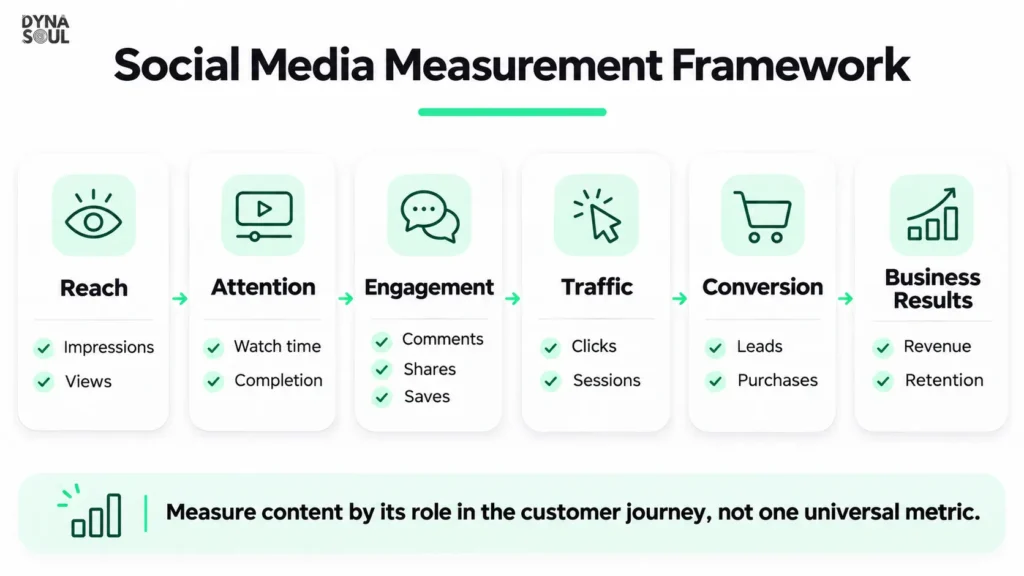
Social reporting becomes more useful when metrics are grouped according to the question they answer.
| Measurement Layer | Examples | What It Helps Answer |
|---|---|---|
| Distribution | Reach, impressions, video views | How much exposure did the content receive? |
| Attention | Watch time, completion behavior, content consumption | Did people stay with the content? |
| Engagement | Comments, shares, saves, replies, reactions | Did the content create a response? |
| Audience | Follower growth, audience quality, returning viewers | Is the brand building a relevant audience? |
| Traffic | Link clicks, sessions, landing-page visits | Did social activity move people to another destination? |
| Conversion | Leads, purchases, registrations, app actions | Did social contribute to a defined business action? |
| Business | Customer acquisition, revenue, retention indicators | How does social connect to broader business performance? |
Not every post needs to succeed at every layer. The metric should reflect the content’s purpose.
Do Not Optimize Around Engagement Rate Alone
Engagement can be useful, but it should not become the only definition of social success.
A humorous post may generate large interaction without attracting the audience the business needs. A niche educational post may reach fewer people but generate qualified conversations, saves, site visits, or sales opportunities.
Brands should examine engagement quality as well as quantity. Who is responding? What are they saying? Does the content attract relevant questions? Are people sharing it for the reason the brand intended?
Use Social Media as a Learning System
One of the most valuable functions of social media is the speed of feedback. Brands can test messages, observe comments, compare formats, and learn which customer problems create attention.
Turn that activity into structured learning by recording:
- Which hooks repeatedly earn attention
- Which questions generate comments or saves
- Which creators or spokespeople resonate
- Which product features need more explanation
- Which objections appear repeatedly
- Which formats create qualified traffic
- Which content themes underperform consistently
The objective is not to repeat every successful post. It is to understand the underlying reason a concept worked and develop the next version intelligently.
Plan Resources Before Expanding the Strategy
Social media may look inexpensive because publishing an organic post does not require a media budget, but maintaining a serious program requires resources.
Potential cost areas include:
- Strategy and planning
- Copywriting
- Graphic design
- Video production and editing
- Creator partnerships
- Photography
- Community management
- Social listening or publishing tools
- Analytics and reporting
- Paid amplification
The team should decide which capabilities are handled internally, which require external support, and which can be shared across channels.
A Step-by-Step Social Media Marketing Strategy for Growing Brands
- Define the business objective social media should influence.
- Research the audience’s needs, questions, behaviors, and platform habits.
- Select priority platforms based on audience fit and strategic role.
- Define the job of each platform.
- Create a small set of sustainable content pillars.
- Choose formats that fit the message and platform.
- Build a realistic content calendar and production cadence.
- Assign clear ownership for creation, approval, publishing, and community management.
- Use creators, customers, founders, and employees where they add value.
- Connect organic learning with paid-social creative and distribution.
- Measure content according to its objective rather than one universal metric.
- Document patterns and use them to improve the next planning cycle.
This framework should evolve as the brand grows. New products, markets, audience segments, team capabilities, and platform behavior can all change the right channel mix and content priorities.
Common Social Media Marketing Strategy Mistakes
Trying to Be Everywhere
Every new platform adds operational complexity. A focused presence with consistent content and community engagement can be more useful than maintaining many weak accounts.
Posting Without a Defined Objective
A content calendar is not a strategy by itself. Every major content program should connect to an audience need and a marketing goal.
Copying the Same Post Across Every Platform
Repurposing is efficient, but simple duplication ignores differences in audience expectations, formats, and platform behavior. Adapt the idea rather than blindly copying the execution.
Making Every Post Promotional
People rarely follow brands only to receive sales messages. Give the audience useful, interesting, entertaining, or relevant reasons to return.
Ignoring Comments and Community Signals
Publishing without listening wastes one of social media’s strongest advantages: direct feedback from the market.
Changing Strategy After Every Weak Post
Individual posts can vary widely. Look for patterns across enough content before making major conclusions about a pillar, format, or platform.
Chasing Trends Without Brand Relevance
A trend can create attention, but attention is not automatically useful. Participate when the brand has a credible, audience-relevant reason to join.
Reporting Vanity Metrics Without Business Context
Follower growth and impressions can matter, but they become more useful when connected to audience quality, engagement, traffic, conversion, and strategic objectives.
FAQ
What is a social media marketing strategy?
A social media marketing strategy is a plan that defines the audience, objectives, priority platforms, content pillars, formats, publishing process, community-management approach, and measurement framework a brand will use across social channels.
Which social media platforms should a growing brand use?
Choose platforms based on where the target audience is meaningfully active, what role the platform can play in the customer journey, and whether the team can consistently produce suitable content. A growing brand does not need to be equally active on every platform.
How often should a brand post on social media?
There is no universal posting frequency. The right cadence depends on the platform, audience, production capacity, content quality, and business objective. Consistency and the ability to learn from performance matter more than forcing an arbitrary volume of posts.
What should a social media content plan include?
A useful plan should include content pillars, formats, platforms, audience segments, campaign objectives, publication dates, creative ownership, approval status, calls to action, and performance notes. It should also leave room for timely opportunities and community-driven content.
Should organic and paid social media be managed together?
They have different distribution and measurement models, but the learning should be connected. Organic content can reveal useful messages and community insights, while paid campaigns can provide additional information about creative, audiences, and conversion behavior.
How do you measure whether a social media strategy is working?
Measure according to the objective. Useful metrics can include reach, attention, engagement quality, audience growth, traffic, leads, purchases, or other business outcomes. Review patterns across content rather than relying on one metric or one post.
Final Thoughts on Building a Social Media Marketing Strategy
A strong social media marketing strategy is not a commitment to publish as much content as possible. It is a system for connecting audience insight, useful creative, community participation, platform choices, and measurable business goals.
Growing brands benefit from starting with a focused channel mix, building repeatable content pillars, listening to audience response, and improving the strategy from real performance data. As the brand gains resources and evidence, the system can expand without losing clarity about what each platform and content program is supposed to accomplish.
If your brand needs support turning social content, community management, and platform planning into a coordinated marketing program, explore Dyna Soul Solutions.


