

A performance marketing strategy gives a brand a structured way to turn paid media spending into measurable business learning and growth. Instead of treating Google Ads, Meta Ads, TikTok Ads, or other channels as separate campaign silos, the strategy connects business goals, audience intent, creative, budget allocation, conversion experience, measurement, and optimization.
The key idea is simple: paid media should not be managed only around what an advertising dashboard says happened. A useful strategy starts with the business outcome the brand wants, defines how success will be measured, assigns each channel a clear role, and creates a repeatable process for testing and improving performance.
This guide explains how brands can build that system without assuming that one channel, one attribution model, or one metric such as ROAS can provide the full answer.
What Is a Performance Marketing Strategy?
A performance marketing strategy is a plan for using measurable marketing activity to achieve defined business outcomes such as sales, qualified leads, subscriptions, customer acquisition, or app installs. It determines what the business wants to achieve, which audiences matter, where media budget should go, what creative should communicate, which conversion actions should be tracked, and how results will influence the next decision.
Performance marketing is often associated with paid advertising because advertising platforms provide detailed campaign data. However, the strategy is broader than media buying. Landing pages, offers, product economics, customer retention, data quality, and creative production can all affect whether paid acquisition is sustainable.
This distinction matters because an advertising campaign can look efficient inside a platform while still failing to create enough profitable business value. The reverse can also happen: a channel may appear less efficient in direct platform reporting while contributing to discovery, demand creation, or later conversions elsewhere in the customer journey.
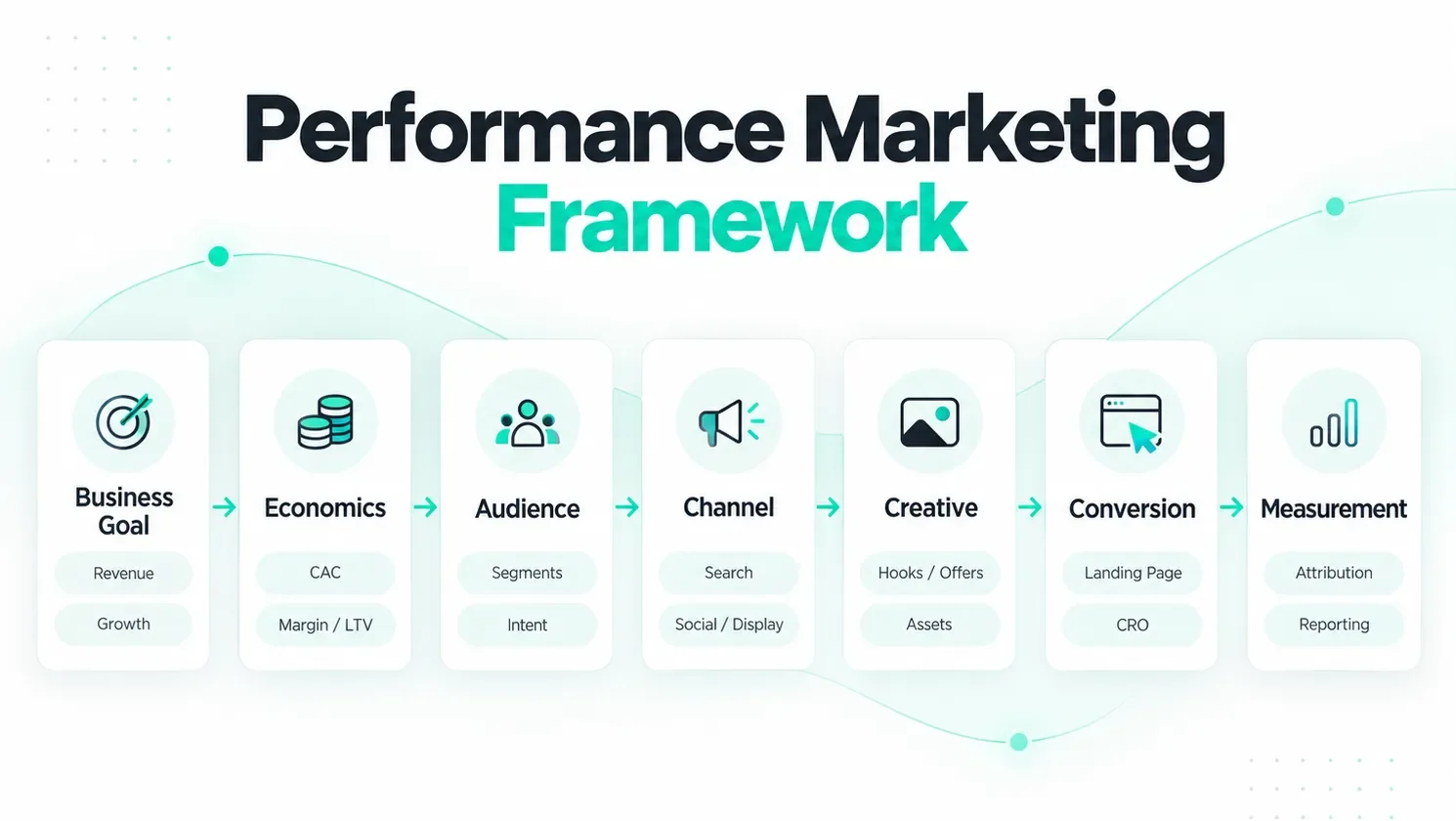
Start With Business Economics, Not the Advertising Platform
A common planning mistake is beginning with a channel question: Should we run Meta Ads? Should we increase Google Ads? Should we test TikTok? Those questions matter, but they should come after the business goal.
The first question should be: what outcome does the company need paid media to influence?
For an e-commerce brand, the answer might be profitable new-customer revenue. For a B2B company, it may be qualified pipeline rather than raw lead volume. For a subscription product, customer value over time can matter more than the first transaction. For an app, the important outcome may be activated users rather than installs alone.
Once the business outcome is clear, the team can work backward into marketing targets.
Understand the Unit Economics
Before deciding what a good CPA or ROAS looks like, understand the economics behind the conversion. Useful inputs may include:
- Average order value or average contract value
- Gross margin or contribution margin
- Refund, return, or cancellation rate
- Repeat purchase behavior
- Customer lifetime value
- Sales close rate for lead-generation businesses
- Fulfilment, payment, or variable operating costs
- The maximum acquisition cost the business can sustain
These inputs explain why industry benchmarks should be treated carefully. Two brands can sell products at the same price and still have very different acceptable acquisition costs because their margins, repeat purchase rates, and operating costs differ.
A benchmark can provide context, but it cannot determine whether a campaign is economically viable for a specific business.
Define the Primary Conversion
Choose the action that best represents real business progress. A purchase, qualified lead, completed subscription, booked consultation, or activated app user may be more useful than a page view or click.
Micro-conversions can still help diagnose the customer journey, but teams should distinguish supporting actions from the outcome they ultimately want to optimize.
For example, an add-to-cart event may help identify friction between product interest and checkout, but it should not automatically be treated as equivalent to a completed purchase.
Map the Customer Journey Before Choosing Channels
Paid media channels work differently because customers use them in different contexts. Someone actively searching for a solution behaves differently from someone watching short-form video, browsing social content, comparing products on a marketplace, or returning to a site after an earlier visit.
A practical channel plan starts by mapping the major stages of the buying journey.
| Customer Stage | Typical Customer Situation | Paid Media Role |
|---|---|---|
| Discovery | The customer may not know the brand or product | Introduce the problem, category, product, or brand |
| Consideration | The customer understands the need and evaluates options | Explain benefits, proof, differences, and objections |
| High intent | The customer is actively looking for a solution | Capture existing demand and make conversion easy |
| Re-engagement | The customer has visited, engaged, or purchased before | Support the next relevant action when economically appropriate |
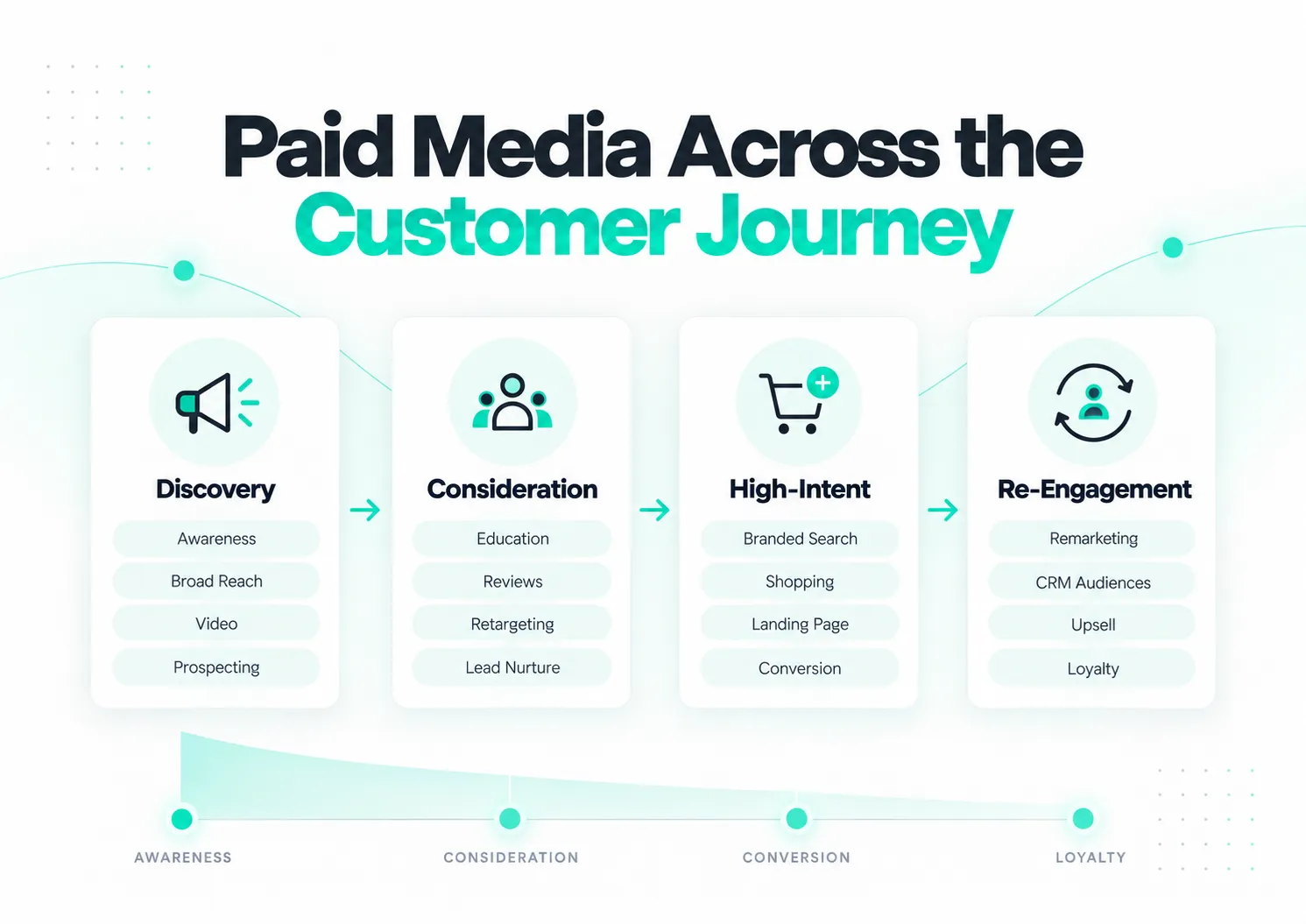
The goal is not to force every channel into every stage. It is to give each channel a clear job.
This also helps prevent teams from evaluating every campaign against exactly the same expectation. A campaign designed to capture high-intent demand may reasonably be measured differently from one designed to introduce a product to people who have never encountered it before.
How to Choose the Right Paid Media Channels
Channel selection should be based on customer behavior, business goals, creative capability, budget, and measurement readiness rather than on which platform is currently receiving the most attention.
1. Match the Channel to Customer Intent
Search advertising can be particularly useful when people already express demand through queries. Paid social and video environments can be useful when the brand needs to create attention, demonstrate a product, explain a problem, or reach relevant audiences before they actively search.
The important question is not whether one platform is universally better than another. It is whether the platform fits the customer’s current level of intent and the role the campaign needs to perform.
2. Evaluate the Creative Requirement
Some channels place a heavier burden on creative volume and variation. If a brand cannot produce enough relevant concepts, demonstrations, testimonials, hooks, or product explanations, campaign performance may become difficult to sustain even when targeting is technically sound.
The creative requirement should therefore be considered before launching a new channel. A team that can produce strong static assets but very little short-form video may face different constraints from a brand with a mature creator-content pipeline.
3. Avoid Fragmenting a Small Budget
Launching many channels at once can spread budget and learning too thin. When each campaign receives limited data, it becomes harder to distinguish a meaningful pattern from normal volatility.
Brands with constrained budgets often benefit from prioritizing the channel or combination most closely aligned with customer intent before expanding.
4. Consider Measurement Readiness
A channel is harder to evaluate if the conversion path cannot be measured reliably. Before expanding spend, confirm that important website, app, lead, or purchase events are being captured consistently and that the team agrees on what each conversion means.
5. Consider Operational Capacity
Every additional platform creates work. Campaign management, creative adaptation, reporting, quality assurance, landing-page coordination, and testing all require resources.
A theoretically attractive channel may not be the right next step if the team lacks the capacity to operate it properly.
Build a Measurement Framework Before Scaling Spend
Measurement should be designed around decisions. Collecting more metrics is not automatically useful if nobody knows what action should follow from them.
A practical framework separates diagnostic campaign metrics from business outcomes.
| Measurement Layer | Examples | What It Helps Answer |
|---|---|---|
| Delivery | Impressions, reach, frequency, spend | Is the campaign delivering as expected? |
| Engagement | Clicks, CTR, video engagement, landing-page visits | Are people responding to the message? |
| Conversion | Purchases, leads, registrations, subscriptions | Is traffic producing meaningful actions? |
| Acquisition | CPA, CAC, new-customer revenue | How efficiently are we acquiring customers? |
| Business | Margin, blended efficiency, lifetime value, profitability | Is the marketing economically sustainable? |
Advertising platforms themselves increasingly depend on conversion data to optimize campaigns. That makes event quality and conversion definitions strategic inputs rather than merely technical implementation details.
Why Platform Reports Do Not Always Match
Advertising platforms, web analytics tools, e-commerce systems, app analytics, CRMs, and finance systems can produce different results because they may use different attribution rules, identity signals, conversion windows, event definitions, or timing.
The objective should not be to force every system to display identical numbers. Instead, define which source is used for which decision: platform data for campaign optimization, CRM data for lead quality, and commerce or finance data for the broader revenue and margin view.
A clear measurement hierarchy also helps teams avoid spending too much time debating which dashboard is correct. Different systems can answer different questions while still contributing to the same decision-making process.
Do Not Build the Strategy Around ROAS Alone
ROAS is useful because it compares attributed revenue with advertising spend. But it cannot answer every strategic question.
A campaign can report strong ROAS because it reaches customers who were already highly likely to purchase. Another campaign may introduce new customers to the brand and appear weaker under a narrow attribution view. A third may create significant revenue but still be unattractive after margins, returns, discounts, and fulfilment costs are considered.
A stronger performance marketing strategy uses several complementary perspectives.
Campaign Efficiency
Use campaign-level metrics to understand which ads, audiences, keywords, placements, or creative concepts are generating useful actions at an acceptable cost.
These metrics are valuable for deciding where campaign-level optimization is needed, but they should not automatically become the final measure of business value.
Customer Acquisition
Track whether marketing is creating new customers or simply harvesting existing demand. Where possible, separate new-customer acquisition from repeat purchases so the team can better understand what the media investment is producing.
Blended Performance
Compare total marketing investment with broader business outcomes. This helps reduce overreliance on the attribution claims of any one platform.
Blended reporting can help answer whether overall customer acquisition and revenue are improving as marketing investment increases, even when individual platforms disagree about which channel deserves credit.
Customer Value
For businesses with meaningful repeat behavior, acquisition cost should also be evaluated alongside the value customers generate over time.
A customer acquired at a higher initial cost may still be valuable if that customer has stronger repeat purchase behavior, retention, or long-term contribution than customers acquired through a cheaper source.
Creative Testing Should Be a Learning System
Creative is not merely the final asset uploaded after the strategy is complete. In many paid media environments, the creative is the strategy that the customer actually experiences.
The strongest testing processes begin with a question or hypothesis rather than a request for more ads.
For example, a team might hypothesize that demonstrating the product immediately will outperform a brand-led introduction. Another test might compare a problem-focused message with a benefit-focused message.
Useful testing variables can include:
- Opening hook
- Problem statement
- Product benefit
- Visual concept
- Creator or spokesperson
- Product demonstration
- Offer
- Social proof
- Call to action
- Ad length or format
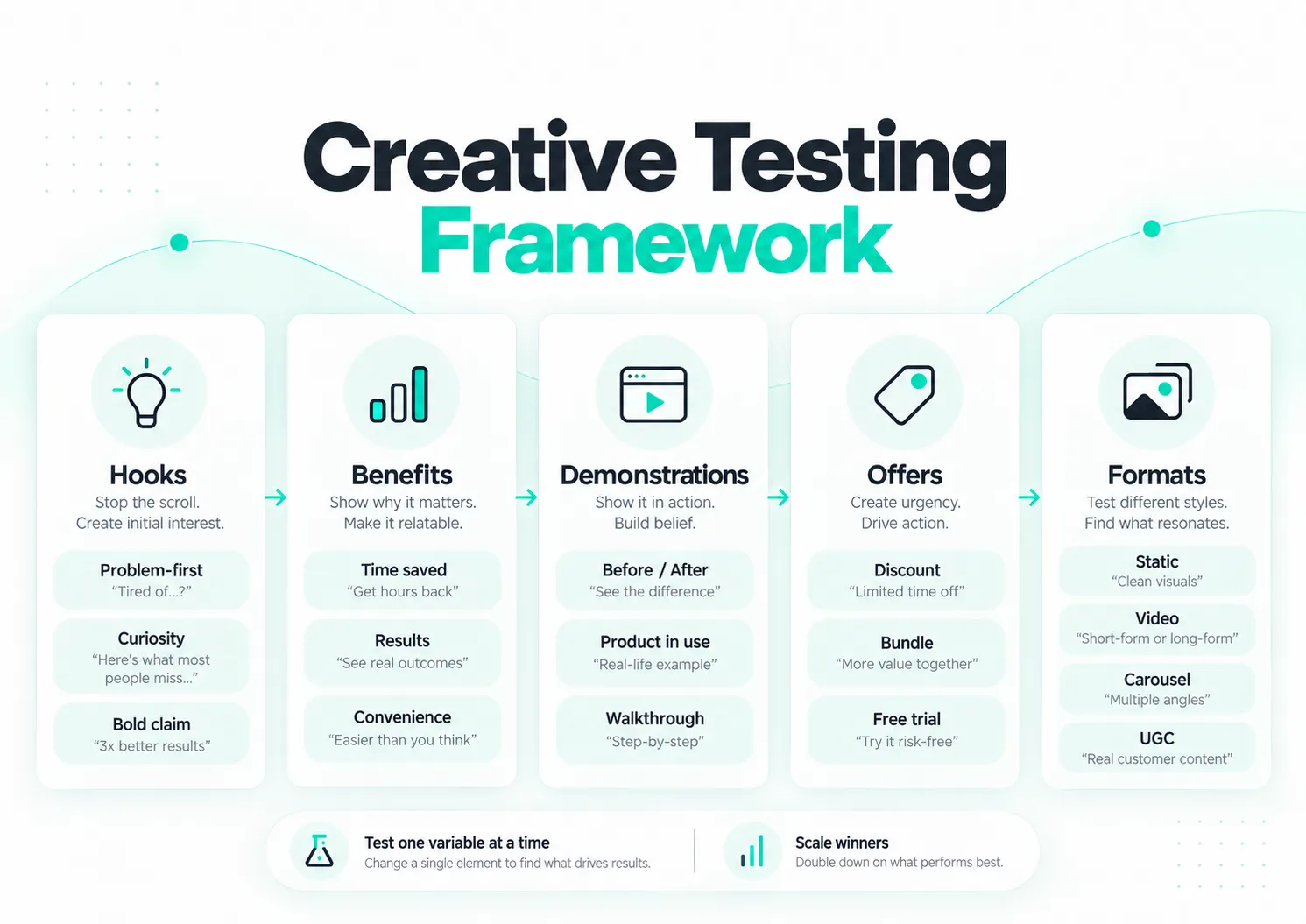
Document the hypothesis, the primary variable being changed, the result, and what should be tested next. This creates cumulative learning instead of a stream of disconnected ad variations.
Test Concepts Before Minor Details
Small creative changes can matter, but brands often learn more by testing meaningfully different concepts before focusing on minor variations.
For example, comparing a product demonstration against a customer-problem story may provide more strategic insight than testing two nearly identical captions.
Once a strong concept is identified, the team can explore variations in hooks, creators, visuals, offers, formats, and calls to action.
How to Allocate a Performance Marketing Budget
There is no universal channel split that works for every brand. Budget allocation should reflect business priorities, channel maturity, audience opportunity, available creative, historical evidence, and the cost of learning.
One practical approach is to divide budget by purpose rather than only by platform.
Core Investment
Allocate the largest stable portion to campaigns that already have a clear role and acceptable economics. These campaigns are not finished; they still require monitoring and improvement, but they have enough evidence to justify continued investment.
Growth Tests
Reserve budget for new audiences, offers, landing pages, creative concepts, campaign structures, or channels. Growth tests should have a clear hypothesis and a predefined decision rule.
Without a defined question, experimentation can quickly become random spending. A useful test should explain what the team expects to learn and what will happen if the result is positive, negative, or inconclusive.
Strategic Experiments
Some tests are designed to explore future opportunities rather than produce immediate mature-channel efficiency. They may include entering a new market, testing a new platform, introducing a new product category, or validating a new creative format.
The exact allocation between these areas will vary by business. The principle is to avoid placing every dollar into today’s winner and leaving no budget for learning.
Landing Pages Are Part of Paid Media Performance
When advertising results weaken, it is easy to focus entirely on bids, audiences, and creative. But the experience after the click can be equally important.
A strong ad cannot fully compensate for a page that is confusing, slow, inconsistent with the message, or difficult to use.
Review questions such as:
- Does the landing page deliver what the advertisement promised?
- Can a visitor understand the value proposition quickly?
- Is the page usable on mobile devices?
- Are price, shipping, eligibility, or other important conditions clear?
- Does the page address the main objections of the target audience?
- Are unnecessary steps creating friction before conversion?
- Is the primary call to action obvious?
Improving conversion experience can make existing media spend more productive without increasing the advertising budget.
Keep the Ad and Landing Page Consistent
Message consistency matters because customers expect the experience after the click to reflect the promise that attracted them.
If an advertisement emphasizes a particular product benefit, use case, audience problem, or offer, the landing page should make that information easy to find rather than forcing the visitor to search for it.
How to Scale Paid Media Without Losing Control
Scaling should mean increasing profitable opportunity, not simply increasing daily budgets.
Higher spend can change the audience mix, auction conditions, frequency, creative fatigue, and marginal acquisition cost.
Before scaling, ask:
- Are the acquisition economics sustainable at the business level?
- Is conversion tracking reliable enough to detect deterioration?
- Does the team have enough creative capacity to support more delivery?
- Is the landing-page and checkout experience ready for additional traffic?
- Are there clear thresholds for reducing, pausing, or reallocating spend?
Scaling can also happen without increasing a campaign budget. A brand can improve conversion rate, increase average order value, strengthen retention, expand into a new market, add a complementary channel, or improve creative productivity.
Watch Marginal Performance
The performance of the next portion of budget can be more relevant to a scaling decision than the historical average alone.
A campaign may have produced attractive results at a lower level of spending but become less efficient as it reaches broader audiences. Teams should therefore monitor how economics change as investment increases rather than assuming past averages will remain constant.
How to Build a Performance Marketing Strategy Step by Step
Brands can use the following process as a practical planning framework:
- Define the business outcome paid media needs to influence.
- Understand margins, customer value, and the acquisition cost the business can sustain.
- Identify the customer’s problems, motivations, objections, and buying journey.
- Choose channels according to customer intent and the role each channel should play.
- Define primary and supporting conversion events.
- Confirm that tracking and reporting are reliable enough for decision-making.
- Create a creative testing system based on documented hypotheses.
- Allocate budget between proven activity and controlled experimentation.
- Review campaign, acquisition, blended, and customer-value metrics together.
- Improve landing pages and conversion experience alongside campaign optimization.
- Record what tests teach the team so future decisions build on previous learning.
- Scale only when economics, measurement, creative capacity, and operations can support additional investment.
This framework is deliberately channel-agnostic. Platforms, advertising formats, automation, and measurement technology will continue to change, but the planning logic remains useful because it begins with the economics and objectives of the business rather than the advertising interface.
A Practical Performance Marketing Example
Consider a hypothetical consumer brand preparing to increase online customer acquisition.
Instead of immediately dividing its budget between several advertising platforms, the team first identifies the acquisition economics the business can realistically support based on product margin, expected customer value, and other variable costs.
Next, the team separates potential customers into broad journey stages. Some people are already searching for products in the category, while others fit the target audience but may not yet know the brand or understand why the product is relevant.
The paid media plan can then assign different jobs to different channels. Search activity may focus on capturing existing demand, while paid social campaigns introduce the product through demonstrations, customer problems, creator-style content, or other relevant concepts.
The creative team develops several distinct hypotheses instead of producing minor variations of one advertisement. Each test is documented so the team can identify which messages, benefits, and formats deserve further investment.
Campaign reporting is then combined with broader business reporting. Advertising dashboards help diagnose campaign-level performance, while e-commerce, CRM, or finance data helps the team understand whether overall customer acquisition remains economically sustainable.
As evidence improves, budget can move toward the combinations that continue to produce useful business outcomes while part of the investment remains available for controlled experimentation.
This is what turns performance marketing from a collection of campaigns into a continuous decision and learning process.
Common Performance Marketing Mistakes
Choosing Channels Before Defining the Objective
Platform selection should follow the business goal and customer journey. Starting with a platform can lead to campaigns that are technically active but strategically unclear.
Using One Metric as the Final Answer
CTR, CPA, ROAS, CAC, and other metrics answer different questions. No single number captures demand creation, acquisition quality, margin, retention, and long-term business value at the same time.
Changing Too Many Variables at Once
If audience, creative, budget, offer, landing page, and bidding approach all change together, the team may improve or reduce performance without learning what actually caused the change.
Spreading Budget Too Thinly
Too many simultaneous channels and experiments can produce insufficient data and unclear conclusions. Concentration can be useful while a brand is still building its initial paid media learning.
Ignoring Creative Fatigue
Campaign settings cannot indefinitely compensate for a limited creative library. Creative development should be planned as an ongoing operating process rather than an occasional campaign task.
Scaling Before Measurement Is Stable
More spend magnifies both strong and weak decisions. If event tracking, attribution, or business reporting is unreliable, scaling creates larger bets based on incomplete information.
Optimizing Revenue Without Checking Profitability
Revenue can grow while profitability deteriorates. Paid media decisions should remain connected to margins, customer value, and the company’s broader financial objectives.
How Often Should Performance Marketing Be Reviewed?
Different decisions require different review periods. Reviewing every metric at the same frequency can encourage unnecessary changes and make normal short-term fluctuations look more important than they are.
Daily Monitoring
Daily checks are useful for operational problems such as tracking failures, unexpected budget movement, rejected ads, broken landing pages, or unusually large changes in campaign delivery.
The purpose is not necessarily to make major strategic changes every day. It is to identify problems that may require immediate attention.
Weekly Optimization
Weekly reviews can examine campaign efficiency, budget pacing, creative trends, conversion performance, audience behavior, and testing results.
This cadence can also help teams determine whether a test has generated enough useful evidence to influence the next media or creative decision.
Monthly or Quarterly Strategy Reviews
Longer review periods are more appropriate for questions about channel mix, acquisition economics, budget allocation, creative production capacity, market expansion, and the overall role of paid media within the business.
Separating operational monitoring from strategic review reduces the risk of making long-term decisions based on ordinary short-term volatility.
FAQ
What is the main goal of a performance marketing strategy?
The main goal is to create a repeatable system for turning measurable marketing investment into business outcomes and learning. That includes deciding what to optimize, which channels to use, how budget should be allocated, how conversions are measured, and how results influence future decisions.
Which paid media channel should a brand start with?
There is no universal first channel. The best starting point depends on where customer intent already exists, how the target audience discovers products, the available budget, creative capability, conversion path, and measurement readiness. A smaller number of well-supported channels can be more useful than launching everywhere at once.
Is ROAS the most important performance marketing metric?
ROAS can be useful, but it should be evaluated alongside customer acquisition cost, new-customer contribution, margins, blended performance, and customer value. The most useful metric depends on the business model and the decision being made.
How often should paid media campaigns be optimized?
Operational issues can be monitored daily, while many optimization decisions are better evaluated over a longer period with enough data to reduce noise. Weekly reviews can be useful for campaign learning, while monthly or quarterly reviews are better suited to channel mix and broader strategic decisions.
How much budget should be reserved for testing?
There is no fixed percentage that applies to every brand. The testing budget should be large enough to produce useful learning without putting core business performance at unnecessary risk. The appropriate level depends on total budget, campaign maturity, conversion volume, and how much uncertainty the company can tolerate.
When is a brand ready to scale paid media?
A brand is in a stronger position to scale when acquisition economics are sustainable, conversion tracking is dependable, creative supply can support additional delivery, the conversion experience is functioning well, and the team has clear thresholds for deciding when to increase, maintain, or reduce spend.
Final Thoughts on Building a Performance Marketing Strategy
A strong performance marketing strategy is less about finding a single winning advertising platform and more about building a disciplined decision system. Business economics define what success means. Customer intent helps determine where to advertise. Creative communicates the value. Measurement shows what happened. Testing converts results into learning. Budget allocation determines where the next investment has the strongest strategic case.
Brands that connect those elements can make paid media decisions with more context and less dependence on isolated dashboard metrics. A well-designed performance marketing strategy can also adapt as channels, creative formats, attribution methods, technology, and customer behavior change.
If your brand needs support turning paid media planning, creative, and measurement into a coordinated growth program, explore Dyna Soul Solutions.


