
Performance marketing costs are easier to understand when they are separated into the different things a brand is actually paying for. The advertising budget sent to Google, Meta, TikTok, or another platform is only one part of the total. Management fees, creative production, tracking, landing-page work, reporting tools, and internal resources can all affect the real cost of running a performance program.
That is why two proposals with the same media budget can have very different total costs. One may include strategy, campaign management, creative testing, and analytics, while another covers only ad-platform execution. A useful comparison starts by defining the scope before comparing the price.
This guide explains the main performance marketing costs, common agency fee models, the factors that change budgets, and a practical way to estimate what your brand should plan for without relying on a universal industry benchmark.
What Do Performance Marketing Costs Include?
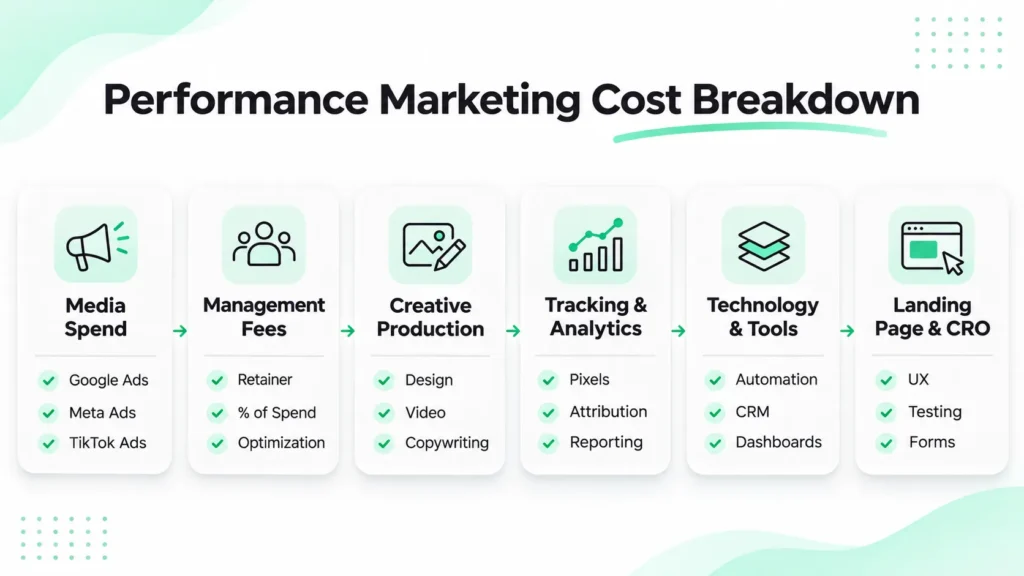
Performance marketing costs usually fall into several separate categories. Keeping them visible makes budgeting easier and prevents management fees from being confused with the money that actually buys advertising inventory.
| Cost Component | What It Covers | Who Usually Receives the Payment |
|---|---|---|
| Media spend | Advertising delivery across paid platforms | Advertising platforms or media partners |
| Management fee | Strategy, campaign setup, optimization, reporting, and account management | Agency, consultant, or internal team |
| Creative production | Ad copy, design, video, UGC, photography, editing, and variations | Agency, creators, production partners, or internal team |
| Tracking and analytics | Conversion setup, analytics configuration, feeds, dashboards, and data quality work | Agency, developer, analytics provider, or software vendor |
| Landing-page work | Page design, development, testing, and conversion improvements | Agency, developer, CRO specialist, or internal team |
| Technology and tools | Reporting, attribution, call tracking, feed management, testing, or other software | Software vendors |
1. Media Spend: The Budget That Buys Advertising
Media spend is the money allocated directly to advertising delivery. It can fund search ads, paid social, video, display, marketplace advertising, app campaigns, or other paid placements.
This amount should be shown separately from agency or consultant fees. If a proposal says the monthly budget is $10,000, for example, the first question should be whether that figure means $10,000 of actual media spend or $10,000 including management and other services.
Google Ads Budget Mechanics
Google Ads generally uses an average daily budget for campaigns. For most campaigns, Google states that spending can be higher or lower on individual days depending on available traffic and opportunity. Its current documentation says the daily spending limit can be up to two times the average daily budget for most campaigns, while the monthly spending limit is generally 30.4 times the average daily budget.
TikTok Ads Budget Minimums
As of November 2026, TikTok Ads Manager documentation states that daily campaign budgets must exceed $50 and daily ad group budgets must exceed $20. Lifetime ad group budgets are calculated using the minimum daily budget multiplied by the scheduled number of days.
These are platform delivery minimums, not recommendations for how much a brand should invest in TikTok advertising. A technically valid budget can still be too small to generate enough conversion volume or learning for a particular business objective.
2. Performance Marketing Management Fees
The management fee pays for the work required to plan, operate, analyze, and improve campaigns. Depending on scope, this can include research, account structure, keyword or audience planning, budget allocation, creative briefs, testing, optimization, reporting, meetings, and strategic recommendations.
The important question is not only how large the fee is. It is what work, responsibility, and level of support the fee includes.
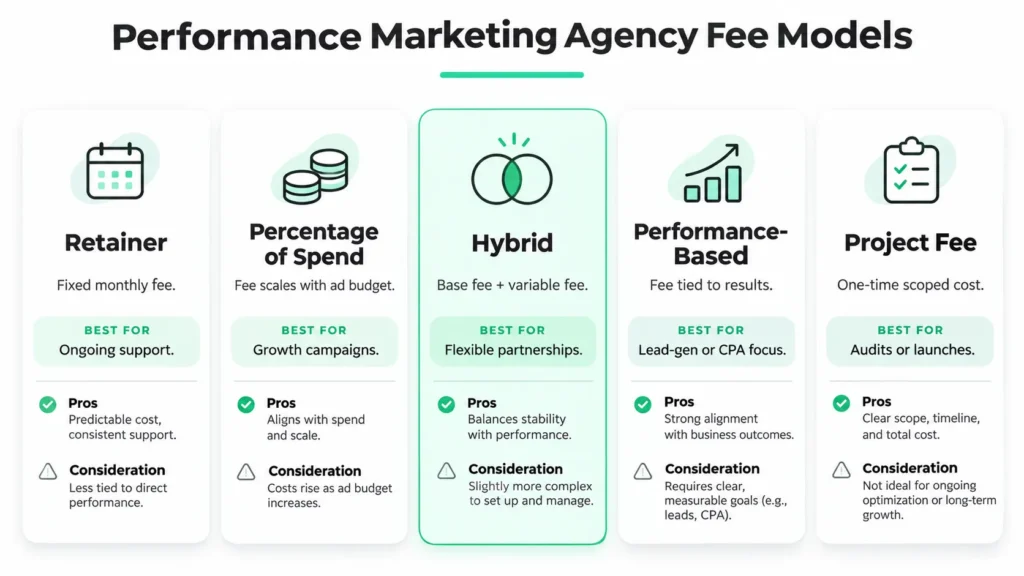
Common fee models include fixed retainers, percentage-of-spend fees, hybrids, performance-based arrangements, and project fees.
Common Performance Marketing Fee Models
Fixed Monthly Retainer
A fixed retainer charges an agreed monthly amount for a defined scope of work. The fee may cover a certain number of platforms, markets, campaigns, meetings, reports, or tests.
The main advantage is predictability. The brand knows the management cost even if media spending changes within the agreed scope.
Percentage of Ad Spend
Under this model, the management fee is calculated as a percentage of the media spend being managed.
Brands should define how budget increases are approved. Because the fee rises when media spend rises, the contract should make it clear that additional spend still needs to make commercial sense for the advertiser.
Hybrid Pricing
A hybrid model combines a fixed base fee with another variable component, such as a percentage of spend or an agreed performance incentive.
Hybrid contracts require clear definitions. Brands should understand what triggers the variable fee, whether there are minimums or caps, and which data source is used to calculate it.
Performance-Based Fees
Performance-based pricing links some or all of the fee to an agreed result, such as qualified leads, sales, revenue, or another measurable outcome.
The model sounds straightforward, but it depends heavily on attribution and definitions. Both sides need to agree on what counts as a valid result, how cancellations or refunds are treated, who controls the offer and landing page, and how revenue from repeat customers is handled.
Project or Setup Fees
Some work is better priced as a defined project rather than an ongoing monthly engagement. Examples include account audits, tracking implementation, campaign builds, product-feed setup, analytics dashboards, or a launch sprint.
This model works well when the deliverable and completion criteria are clear. The limitation is that a one-time project does not automatically include ongoing optimization after launch.
How the Main Fee Models Compare
| Fee Model | Best Fit | Main Advantage | What to Check |
|---|---|---|---|
| Fixed retainer | Stable ongoing scope | Predictable management cost | Exactly what work is included |
| Percentage of spend | Programs where workload scales with media activity | Simple formula that scales automatically | Budget approval rules, minimums, and caps |
| Hybrid | Stable base workload plus variable complexity or upside | Balances predictability and scalability | How the variable component is calculated |
| Performance-based | Clear, measurable outcomes with trusted attribution | Part of the fee is linked to results | Attribution, quality rules, refunds, and definitions |
| Project fee | Audits, setup, launches, or defined builds | Clear deliverable and cost | What happens after the project ends |
No model is automatically better. The better choice is the one that reflects the actual work, creates clear incentives, and allows both sides to understand how the fee changes when the scope changes.
3. Creative Production Costs
Creative is often one of the most underestimated performance marketing costs. Paid media needs assets that fit the platform, audience, stage of the funnel, and campaign objective. A single brand video or static design may not provide enough variation for continuous testing.
Creative costs can include:
- Ad copy and concept development
- Graphic design
- Product photography
- Video production and editing
- UGC or creator content
- Motion graphics
- Localization for different markets
- Resizing and adapting assets for multiple placements
- New variations created from testing results
A proposal should clarify whether these items are included in the management fee, billed separately, produced by the brand, or handled by another partner.
4. Tracking, Analytics, and Technology Costs
Performance marketing depends on reliable measurement. That can create setup or software costs that are easy to overlook when comparing media-management quotes.
Depending on the business, the work may involve conversion tracking, analytics configuration, product feeds, CRM integration, server-side or API-based data connections, call tracking, dashboards, or attribution tools.
The important budgeting principle is to treat measurement as part of the performance system rather than an optional reporting add-on. A cheaper media program is not necessarily cheaper if poor tracking causes the team to allocate a much larger advertising budget using unreliable information.
5. Landing Pages and Conversion Work
Media cost and conversion cost are connected. If a landing page converts poorly, the brand may need more clicks and more advertising spend to generate the same number of customers.
Landing-page costs can include design, development, copywriting, testing, mobile optimization, checkout improvements, or experimentation tools.
What Factors Increase Performance Marketing Costs?
Two brands with similar media budgets can require very different levels of work. The following factors commonly increase total cost:
- More advertising platforms: Each additional channel creates setup, management, creative, and reporting requirements.
- More markets or languages: International campaigns may require localization, different offers, currency considerations, and additional account structures.
- More products or business units: Larger catalogs and multiple product lines create more campaign and feed complexity.
- Higher creative velocity: Frequent testing requires more concepts, production, editing, and versioning.
- Complex tracking: CRM integration, app events, offline conversions, or multiple data systems can require specialist work.
- Custom reporting: Executive dashboards and cross-platform reporting add work beyond standard platform reports.
- Landing-page development: Building and testing pages adds design and development costs.
- Long sales cycles: B2B or high-consideration purchases may require CRM data and lead-quality analysis rather than simple platform conversion reporting.
How Much Should a Brand Spend on Performance Marketing?
There is no universal monthly amount that is appropriate for every brand. A useful budget starts with economics and objectives rather than a generic percentage.
One simple planning relationship is:
Target acquisition cost × target number of new customers = initial media-budget estimate
This is a planning equation, not a performance guarantee. Actual acquisition cost can change as spending increases, competition changes, creative fatigues, conversion rates move, or the campaign reaches broader audiences.
The brand should then add the non-media costs required to operate the program:
Total performance marketing budget = media spend + management + creative + tracking/technology + landing-page or conversion work
A Practical Budget-Building Process
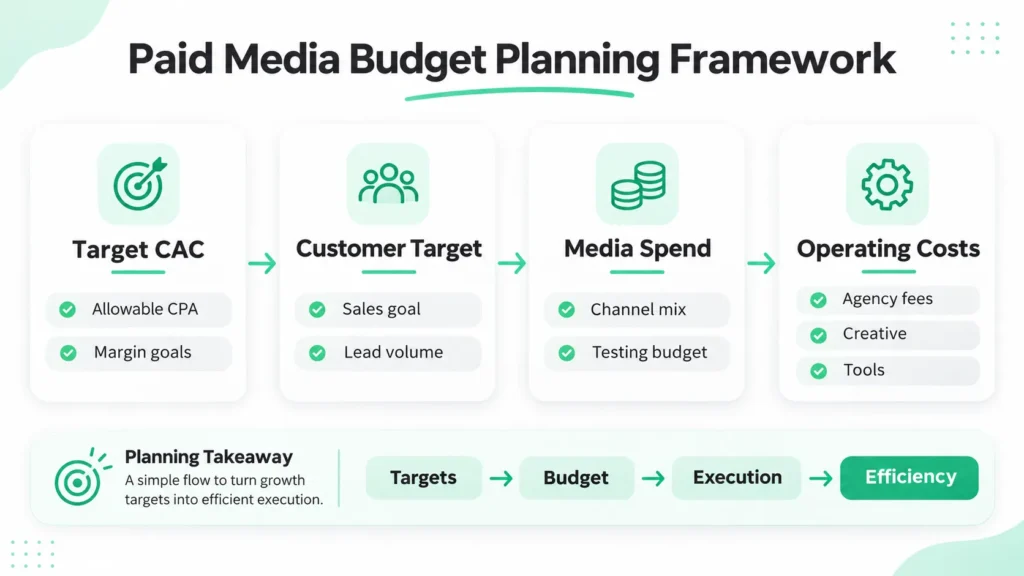
1. Start With Sustainable Acquisition Economics
Determine what the business can afford to spend to acquire a customer while still supporting its margin and financial objectives. For businesses with repeat purchases or subscriptions, consider customer value over an appropriate time period rather than only the first transaction.
2. Separate Media Spend From Service Fees
Keep the money buying advertising separate from the cost of managing it. This makes proposals easier to compare and helps finance teams understand where budget changes are occurring.
3. Account for Creative Before Launch
Decide how many useful concepts and variations the campaign needs and who will produce them. A media budget without a creative plan may be difficult to scale.
4. Budget for Measurement and Conversion Work
Confirm whether tracking, feeds, dashboards, landing pages, and analytics work already exist or need additional investment.
5. Reserve Budget for Learning
Do not assume every dollar should go immediately to the current best-performing campaign. New creative, audiences, offers, landing pages, and channels require controlled testing if the brand wants to discover additional growth opportunities.
6. Review Marginal Returns as Spend Increases
The question is not only whether historical campaigns were profitable. The more important scaling question is whether the next portion of budget is likely to produce acceptable business value.
How to Compare Performance Marketing Proposals
Comparing only the management-fee number can be misleading. A lower quote may exclude work that another proposal includes.
Before choosing a provider, ask:
- Is media spend included in the quoted number or paid separately?
- Which platforms and markets are included?
- Are campaign setup and account restructuring included?
- Who produces creative assets?
- How many creative concepts or revisions are included?
- Is tracking implementation included?
- Are dashboards or reporting tools extra?
- Who handles landing-page recommendations and implementation?
- Are there minimum fees, spending thresholds, or contract caps?
- How are performance incentives calculated?
- Which data source determines performance-based payments?
- Who owns the advertising accounts, data, and creative after the engagement ends?
Common Performance Marketing Cost Mistakes
Comparing Agency Fees Without Comparing Scope
A low fee is not automatically better if strategy, creative, tracking, or reporting must be purchased separately.
Treating Platform Minimums as Recommended Budgets
A platform may allow a campaign to launch at a certain minimum budget, but that does not mean the amount is sufficient to achieve a specific business objective or generate reliable learning.
Putting the Entire Budget Into Media
Advertising delivery needs creative, measurement, and conversion infrastructure. Underfunding those areas can make the media budget less productive.
Assuming a Higher ROAS Always Means a Better Investment
Reported ROAS does not automatically account for margin, new versus existing customers, returns, or how much additional demand the campaign actually created.
Choosing a Fee Model Before Defining the Work
The appropriate commercial model becomes clearer after the brand understands the channels, markets, deliverables, testing requirements, reporting, and responsibility involved.
FAQ
What are the main performance marketing costs?
The main costs usually include media spend, campaign management, creative production, tracking and analytics, landing-page or conversion work, and any required software or reporting tools. The mix depends on what the brand already handles internally and what is included in the external scope.
Is ad spend included in a performance marketing agency fee?
Not necessarily. Media spend and agency fees are usually separate economic components, but proposals can be presented in different ways. Always ask whether the quoted amount includes the advertising budget or only the services used to manage it.
How do performance marketing agencies charge?
Common models include fixed monthly retainers, a percentage of media spend, hybrid arrangements, performance-based fees, and one-time project or setup fees. The right model depends on scope, attribution, workload, and how the program is expected to change over time.
Is percentage-of-ad-spend pricing better than a retainer?
Neither model is automatically better. Percentage pricing can scale easily with media activity, while a retainer can provide more predictable management costs. The important issue is whether the fee reflects the actual scope and whether budget increases remain tied to sound business decisions.
What is the minimum budget for performance marketing?
There is no universal minimum that applies to performance marketing as a whole. Individual advertising platforms may impose technical minimums, but the budget needed to generate useful results depends on the target customer, conversion rate, acquisition economics, market competition, channel, and campaign objective.
How should a brand estimate its performance marketing budget?
Start with sustainable customer acquisition economics and the number of customers or conversions the business wants to generate. Then add the management, creative, tracking, technology, and conversion-related costs required to operate the program. Review the budget as real performance data becomes available.
Final Thoughts on Performance Marketing Costs
Performance marketing costs make more sense when the budget is broken into its real components. Media spend buys advertising exposure and traffic. Management pays for strategy and optimization. Creative gives campaigns something useful to test. Measurement helps the team understand what happened, while landing-page and conversion work determine how effectively traffic becomes business value.
The right budget is therefore not simply the lowest agency fee or the largest media spend. It is the combination of investment, capability, and measurement that gives the brand enough information to make economically sound decisions and improve performance over time.
If your brand is evaluating how paid media, creative, and campaign management should fit into its growth budget, explore Dyna Soul Solutions.


