
An influencer marketing strategy gives a brand a structured way to work with creators for a specific business purpose rather than treating every collaboration as a one-off social post. The strategy connects audience fit, creator selection, campaign design, content rights, disclosure, measurement, and commercial outcomes so the brand can learn what works and improve the next campaign.
For brands, the difficult part is rarely finding someone with followers. The harder questions are whether the creator reaches the right people, whether the content feels credible, whether the partnership terms are clear, and whether the campaign produces useful business value. A strong influencer marketing strategy answers those questions before content goes live.
This guide explains how to move from creator discovery to measurable results without assuming that follower count, engagement rate, or direct sales alone can define success.
What Is an Influencer Marketing Strategy?
An influencer marketing strategy is a plan for using creators, influencers, or key opinion leaders to achieve defined marketing and business objectives. It determines who the brand wants to reach, what role creators should play, how partners will be selected, what content will be produced, how commercial terms will work, and how results will be measured.
The strategy should also define what happens after a post is published. Useful creator content can sometimes be repurposed, amplified through paid media when rights allow, used as social proof, or adapted for other stages of the customer journey. That means influencer marketing is not only a media-buying decision. It is also a content, relationship, rights, measurement, and brand-governance decision.
Start With the Campaign Objective, Not the Creator List
A common mistake is beginning with a spreadsheet of influencers before defining what the campaign is supposed to accomplish. This makes follower count or creator popularity the decision driver rather than the business objective.
Start by defining the outcome. Common objectives can include:
- Introducing a brand or product to a relevant audience
- Building consideration through demonstrations, reviews, or education
- Generating traffic to a website, marketplace, or app store
- Driving trackable sales, leads, installs, or registrations
- Producing creator-led content that can be reused with appropriate rights
- Supporting a product launch or market entry
- Building a longer-term ambassador relationship
The objective affects almost every later decision. A launch focused on reach may need a different creator mix from a campaign designed to generate attributable purchases. A brand that primarily wants reusable content may evaluate creators more heavily on production quality and licensing terms than on audience size.
Define the Audience Before Evaluating Creators
Creator selection works better when the brand has a clear picture of the people it wants to influence. Demographics can help, but they are not enough.
Consider questions such as:
- What problem is the audience trying to solve?
- Which topics, communities, and creators already influence their decisions?
- What objections might prevent them from buying?
- Which platforms do they use for discovery, research, entertainment, or purchase decisions?
- What type of creator voice would feel credible in the category?
- Is the audience local, regional, or global?
The closer the creator’s normal audience and subject matter are to the brand’s intended customer, the less the partnership has to rely on a forced product placement.
How to Choose Influencers for a Brand Campaign
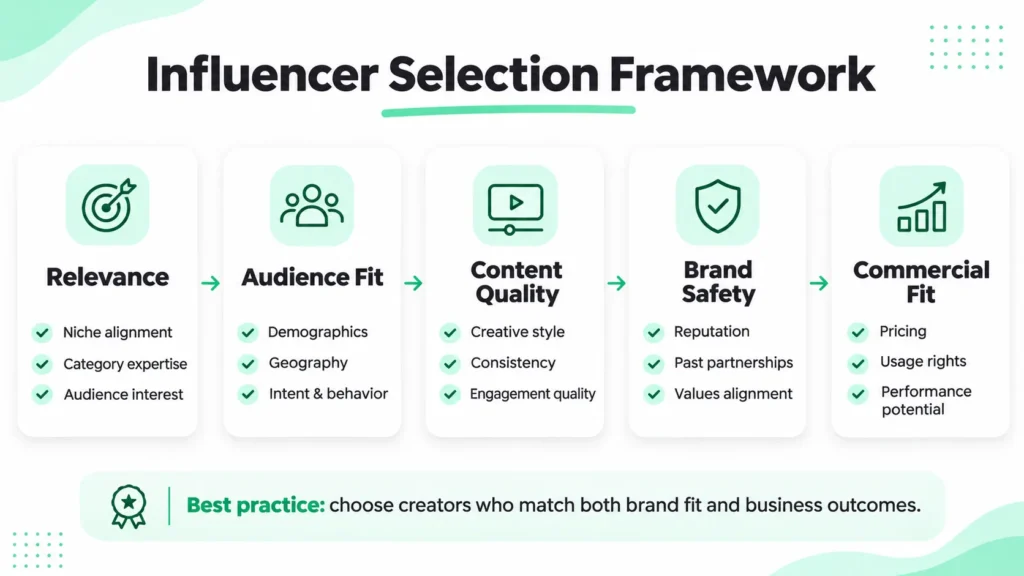
The best creator is not automatically the one with the largest audience. A practical evaluation should combine relevance, audience quality, content quality, commercial fit, and risk.
1. Category and Content Relevance
Review what the creator normally talks about, not only the topics listed in a media kit. A strong fit usually means the product can appear naturally within the creator’s existing content style and audience expectations.
For example, a skincare brand may learn more from a creator who consistently explains routines and ingredients to a focused audience than from a larger general-entertainment account with little connection to beauty or personal care.
2. Audience Fit
Look beyond total followers. Where possible, review audience geography, language, age distribution, interests, and other relevant characteristics. The exact data available will vary by platform and creator.
A creator with a smaller but highly relevant audience can be strategically stronger than a much larger account whose followers are mostly outside the target market.
3. Content Quality and Creator Voice
Influencer content works partly because people choose to follow the creator. That relationship can weaken if the sponsored content suddenly sounds like a corporate script.
Evaluate whether the creator can explain products clearly, hold attention, demonstrate use cases, tell stories, and maintain a recognizable voice while still communicating required brand information.
4. Engagement Quality
Do not treat engagement rate as a standalone quality score. Review the actual interaction. Useful comments, questions, product discussions, saves, shares, or recurring community participation can be more informative than a raw number.
Also look for unusual patterns that may warrant further review, such as large follower counts with very limited authentic interaction or repetitive, low-quality comments.
5. Brand Safety and Reputation
Review recent and older content for behavior, claims, partnerships, or topics that could create an avoidable brand risk. The depth of review should reflect the campaign, industry, market, and potential exposure.
Brands in regulated or sensitive categories may need additional legal or compliance review before approving a creator or a claim.
6. Commercial Fit
A creator can be a strong audience fit but still be difficult for a particular campaign if the fee, rights, timeline, exclusivity requirement, or production process does not fit the budget or objective.
Evaluate the full commercial package, not only the posting fee.
Creator Size Is a Planning Variable, Not a Quality Ranking
Terms such as nano, micro, mid-tier, macro, and celebrity influencer are widely used, but follower-count definitions vary across agencies, platforms, markets, and reports. It is more useful to treat audience size as one planning variable rather than a universal hierarchy.
| Creator Characteristic | Potential Strategic Value | What to Check |
|---|---|---|
| Smaller, focused audience | Niche relevance, community familiarity, easier creator diversification | Audience fit, content quality, operational workload |
| Larger creator audience | Broader distribution and stronger visibility | Relevance, audience overlap, cost, brand fit |
| Specialist or expert creator | Education, explanation, category credibility | Qualifications where relevant, claim accuracy, audience trust |
| Entertainment-led creator | Attention, storytelling, cultural reach | Natural product integration and brand suitability |
A campaign may use several creator profiles at once. The right mix depends on the goal, not on a rule that one creator tier is always better.
Choose the Right Collaboration Model
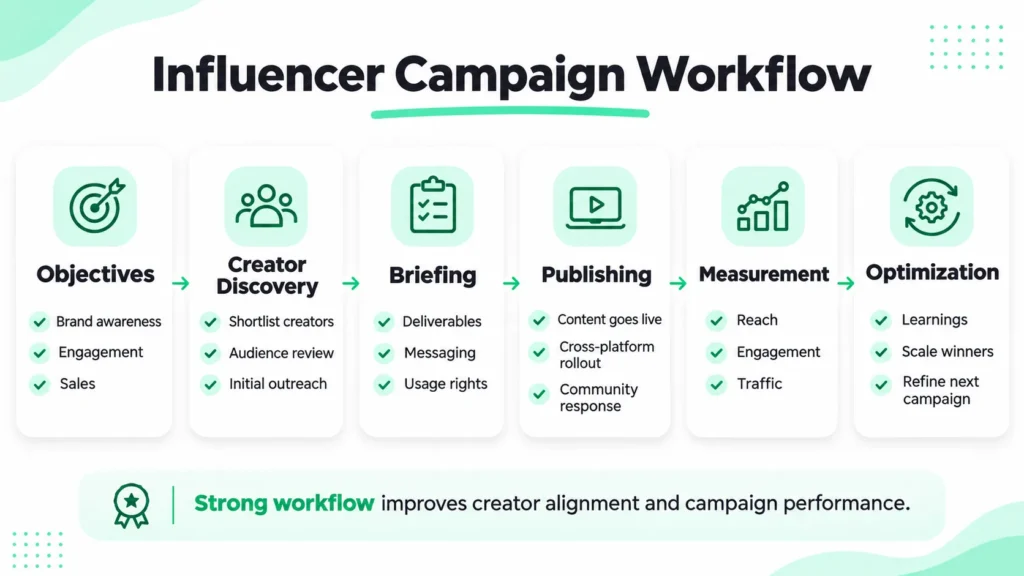
Influencer partnerships can be structured in different ways, and each model creates different expectations for the brand and creator.
Paid Sponsored Content
The brand pays for agreed content deliverables such as videos, posts, stories, livestream segments, or other formats. The agreement should define deliverables, timing, approval, disclosures, and usage rights.
Product Seeding or Gifting
A brand provides a product with the hope of generating consideration or content. Gifting does not automatically guarantee publication unless that requirement is part of an agreement.
Brands should also remember that receiving free or discounted products can create a material connection that may require disclosure depending on the market and circumstances.
Affiliate or Commission-Based Partnerships
The creator receives compensation linked to trackable actions such as purchases or leads. This can align part of the compensation with performance, but tracking rules, attribution periods, returns, cancellations, and code sharing should be defined clearly.
Long-Term Ambassador Programs
Longer relationships can create repeated exposure and give creators more time to understand the product. They may also produce more natural content than a single isolated collaboration.
Long-term partnerships require careful attention to exclusivity, content volume, renewal terms, and performance review.
Content Production and Licensing
Sometimes the creator’s value is the content itself rather than distribution to the creator’s audience. In these cases, the agreement should clearly state where the brand can use the content, for how long, in which territories, and whether paid advertising is included.
Build a Creator Brief Without Removing Authenticity
A good brief gives the creator enough structure to protect the brand while leaving enough flexibility for the content to feel native to the creator’s channel.
A useful brief can include:
- Campaign objective
- Target audience
- Product background and key benefits
- Required facts or messages
- Claims that must not be made
- Mandatory disclosure requirements
- Required tags, links, codes, or calls to action
- Deliverable format and technical requirements
- Key dates and review deadlines
- Examples of content the brand likes or dislikes
Avoid scripting every sentence unless the format or compliance requirement genuinely requires it. The creator usually understands how to communicate with their own audience better than a brand team writing in an unfamiliar creator voice.
Influencer Contracts Should Cover More Than the Posting Fee
Clear commercial terms reduce confusion and protect both sides. The exact contract will depend on the campaign and jurisdiction, but brands should consider areas such as:
- Deliverables and platforms
- Publication dates and campaign windows
- Draft submission and approval process
- Number and scope of revisions
- Payment amount and payment timing
- Products, travel, or other benefits provided
- Disclosure obligations
- Usage and licensing rights
- Paid advertising or amplification rights
- Length of the usage period
- Territories where content can be used
- Category exclusivity and its duration
- Cancellation or missed-deliverable terms
- Required analytics or reporting
Usage rights deserve particular attention. Permission to publish content on a creator’s own account does not automatically mean a brand should assume it can reuse that content indefinitely across websites, paid ads, marketplaces, email, or other channels.
Disclosure and Transparency Are Part of the Strategy
Influencer marketing needs clear disclosure when a material commercial relationship exists. Requirements vary by jurisdiction, so brands should confirm the rules that apply to the creator, advertiser, content, and target market.
In the United States, the Federal Trade Commission advises influencers to disclose financial, employment, personal, family, or other material relationships with brands. Free or discounted products can also create a relationship that needs disclosure. The FTC says disclosures should be clear, easy to notice, and placed with the endorsement rather than hidden in a profile or after a long list of hashtags.
Platform rules can add another layer. TikTok’s current creator guidance requires the commercial content disclosure setting when a post promotes a brand, product, or service. The platform uses labels such as Paid partnership or Promotional content depending on the relationship.
Disclosure should therefore be treated as a campaign requirement from the briefing stage, not something added after the creator has already produced the content.
How to Measure Influencer Marketing Performance
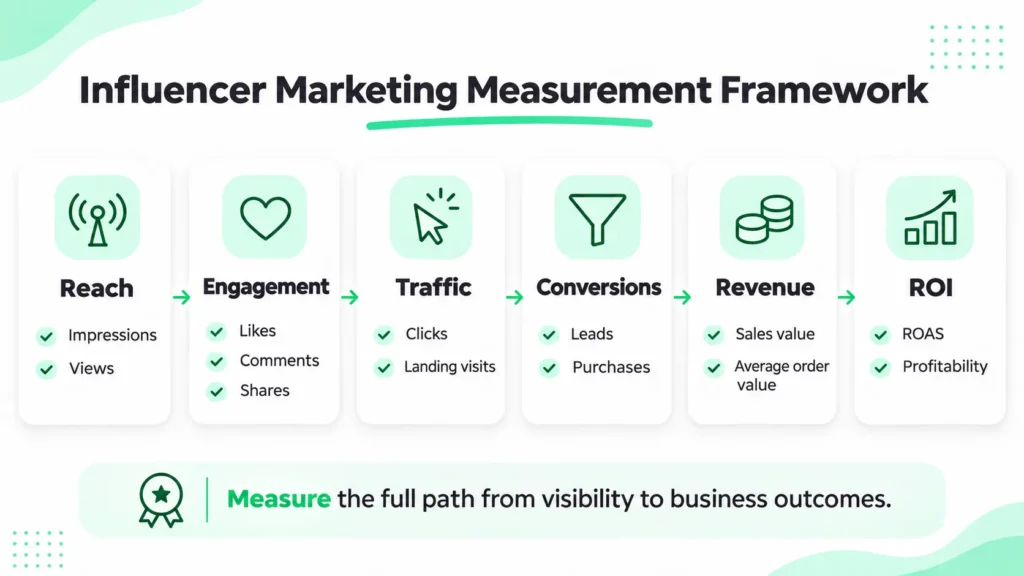
Measurement should follow the campaign objective. A campaign designed for awareness should not be judged only by direct sales, while a campaign designed to generate purchases should not stop at impressions and likes.
| Objective | Useful Measures | Important Limitation |
|---|---|---|
| Awareness | Reach, impressions, video views, audience exposure | Exposure does not prove purchase intent |
| Engagement | Comments, shares, saves, replies, engagement quality | Interaction does not automatically equal business value |
| Traffic | Link clicks, sessions, landing-page behavior | Some journeys may not use the tracked link |
| Conversion | Purchases, leads, installs, registrations, code usage | Attribution may miss cross-device or delayed behavior |
| Revenue | Attributed revenue, average order value, new-customer revenue | Revenue is not the same as profit |
| Content value | Usable assets, winning concepts, paid-media performance when licensed | Requires clear usage rights and a defined valuation method |
Use Multiple Tracking Methods When Appropriate
Depending on the campaign, measurement can combine tracked links, UTM parameters, creator-specific discount codes, affiliate links, platform analytics, website or app conversion data, and post-purchase surveys.
No single method captures every customer journey perfectly. Someone may see creator content, search for the brand later, and purchase without using the creator’s link or code. Another customer may use a shared discount code without ever seeing the original creator post.
Brands should therefore define what each measurement method can and cannot prove.
How to Calculate Influencer Marketing ROI
Influencer marketing ROI should compare the economic value created by the campaign with the total cost required to run it.
A simple financial framework is:
ROI = (campaign return – total campaign cost) / total campaign cost × 100
The difficult part is defining “campaign return.” Using attributed revenue may be simple, but revenue is not profit. A more conservative business analysis may use attributable gross profit or contribution rather than top-line sales when the necessary data is available.
Total campaign cost should also be broader than creator fees alone. Depending on the campaign, include:
- Creator fees
- Product and shipping
- Agency or management costs
- Production expenses
- Usage-rights or licensing fees
- Paid amplification
- Affiliate commissions
- Tracking or technology costs
For awareness campaigns, a clean financial ROI may not be possible. In that case, report the campaign against the objective it was designed to influence and avoid inventing a monetary value for every impression or engagement.
Separate Influencer ROAS From Influencer ROI
ROAS and ROI answer different questions. ROAS generally compares attributed revenue with advertising or campaign spend. ROI considers the return relative to the broader cost of producing that return.
For example, a campaign may generate substantial attributed revenue but also require significant creator fees, production, paid amplification, commissions, and product costs. Looking only at revenue divided by creator spend can make the economics appear stronger than they really are.
Define the formula before the campaign starts so everyone understands what the reported number means.
Budget for the Full Influencer Marketing Program
An influencer marketing budget can include more than creator payments. A practical plan may account for:
- Creator fees
- Product samples and fulfilment
- Creator research and outreach
- Campaign management
- Content production support
- Usage rights and licensing
- Paid amplification
- Affiliate commissions
- Events or travel where relevant
- Tracking and reporting tools
Creator pricing varies substantially by market, platform, creator demand, content complexity, rights, exclusivity, turnaround time, and campaign scope. Generic price-per-follower formulas should therefore be treated carefully.
A Step-by-Step Influencer Marketing Strategy for Brands
- Define the business and marketing objective.
- Identify the target audience and the role creators should play in the customer journey.
- Set the campaign budget, including non-creator costs.
- Build creator selection criteria around relevance, audience, content quality, risk, and commercial fit.
- Shortlist creators and review their content and audience data.
- Choose the appropriate partnership model.
- Negotiate deliverables, rights, disclosure, reporting, timelines, and payment terms.
- Create a brief that protects essential brand requirements without over-scripting the creator.
- Confirm tracking and measurement before content goes live.
- Review content, disclosures, links, codes, and technical requirements before publication.
- Measure results against the original campaign objective.
- Document which creators, messages, formats, and audience insights should inform the next campaign.
Common Influencer Marketing Strategy Mistakes
Choosing Creators Mainly by Follower Count
Audience size does not automatically indicate relevance, trust, content quality, or commercial value. Creator selection should start with the target customer and campaign objective.
Using the Same Brief for Every Creator
A common core brief is useful, but forcing every creator into the same script can remove the voice that made the partnership attractive in the first place.
Ignoring Usage Rights
Brands can create legal and commercial problems if they assume sponsored content can automatically be reused everywhere. Rights should be agreed before the campaign launches.
Measuring Awareness Campaigns Only by Sales
Direct revenue matters when conversion is the objective. But an awareness campaign should also be evaluated using the measures that reflect the job it was designed to perform.
Reporting Engagement Without Looking at Quality
A high interaction count can hide low-quality engagement. Review what people are actually saying and doing, not only the aggregate number.
Forgetting Disclosure Until Publication Day
Disclosure requirements should be included in the brief and contract so creators know what is expected before producing content.
Running One-Off Campaigns Without Capturing Learning
Each campaign should improve the next one. Record creator performance, content patterns, audience responses, operational issues, rights, and measurement lessons instead of starting from zero every time.
FAQ
What should an influencer marketing strategy include?
An influencer marketing strategy should define the campaign objective, target audience, creator-selection criteria, partnership model, budget, content brief, commercial terms, usage rights, disclosure requirements, measurement plan, and the process for using campaign learning in future activity.
How do brands choose the right influencers?
Brands should evaluate relevance, audience fit, content quality, engagement quality, reputation, brand safety, commercial terms, and the creator’s ability to deliver the type of content the campaign requires. Follower count is useful context but should not be the only selection criterion.
How many influencers should a brand work with?
There is no universal number. The appropriate creator mix depends on budget, campaign objective, audience size, market, creator fees, expected content volume, and how much operational capacity the brand has to manage relationships and approvals.
How is influencer marketing ROI measured?
For conversion-focused campaigns, ROI can compare the economic return generated with the total campaign cost. Brands should define whether the return uses revenue, gross profit, contribution, or another measure and include all material campaign costs rather than creator fees alone.
Do gifted products need to be disclosed?
They can. In the United States, FTC guidance says free or discounted products can create a material relationship that should be disclosed when the creator mentions the product. Other countries and platforms may have their own requirements, so brands should verify the rules that apply to each campaign.
Should brands reuse influencer content in paid ads?
Creator content can sometimes be valuable for paid media, but the brand should secure the appropriate usage and advertising rights first. The agreement should specify where the content can be used, for how long, in which territories, and whether editing or paid amplification is permitted.
Final Thoughts on Building an Influencer Marketing Strategy
A strong influencer marketing strategy connects creator relationships to a defined marketing objective. It starts with the audience, selects creators for relevance rather than popularity alone, gives them enough structure without eliminating authenticity, and establishes commercial, rights, disclosure, and measurement requirements before content goes live.
The most useful programs also create learning beyond a single post. Brands can identify which creators generate meaningful audience response, which messages deserve further testing, which content can support other channels, and which partnerships are worth developing over time.
If your brand needs support coordinating creator discovery, campaign management, content, and measurement, explore Dyna Soul Solutions.


