

TikTok AI advertising in 2026 is no longer limited to automatically choosing an audience or generating a piece of ad copy. TikTok is increasingly applying artificial intelligence across campaign setup, targeting, search advertising, creative generation, asset selection, creator discovery, commerce optimization, and reporting.
For brands, that creates both opportunity and complexity. Campaigns can require less manual configuration, creative teams can produce more variations, and commerce advertisers can automate decisions that previously required daily adjustments. At the same time, advertisers still need to decide what the system should optimize toward, which creative is appropriate, whether conversion signals are reliable, and when automation is producing useful business results rather than simply more activity.
This guide explains the major TikTok AI advertising developments shaping the platform in 2026, including Smart+, TikTok Symphony, automated Search Ads, AI-powered creative selection, and GMV Max. More importantly, it explains what brands should change in their own advertising workflows as these systems become more automated.
What Does TikTok AI Advertising Mean in 2026?
TikTok AI advertising is best understood as a collection of systems rather than one product.
Artificial intelligence now plays several different roles inside TikTok’s advertising ecosystem:
- Automating campaign setup and optimization
- Finding and expanding audiences
- Matching ads to search intent
- Generating video, images, scripts, avatars, and voiceovers
- Selecting creative assets for campaigns
- Refreshing creative during campaign delivery
- Matching brands with creator content
- Optimizing TikTok Shop advertising
- Generating contextual calls to action
- Helping advertisers analyze and manage larger creative libraries
This means the strategic question is no longer simply whether a brand should “use AI.”
The more useful question is which decisions should be automated, which should remain controlled by the advertiser, and what inputs the AI needs to make useful decisions.
Smart+ Is Becoming TikTok’s Main Campaign Automation Layer
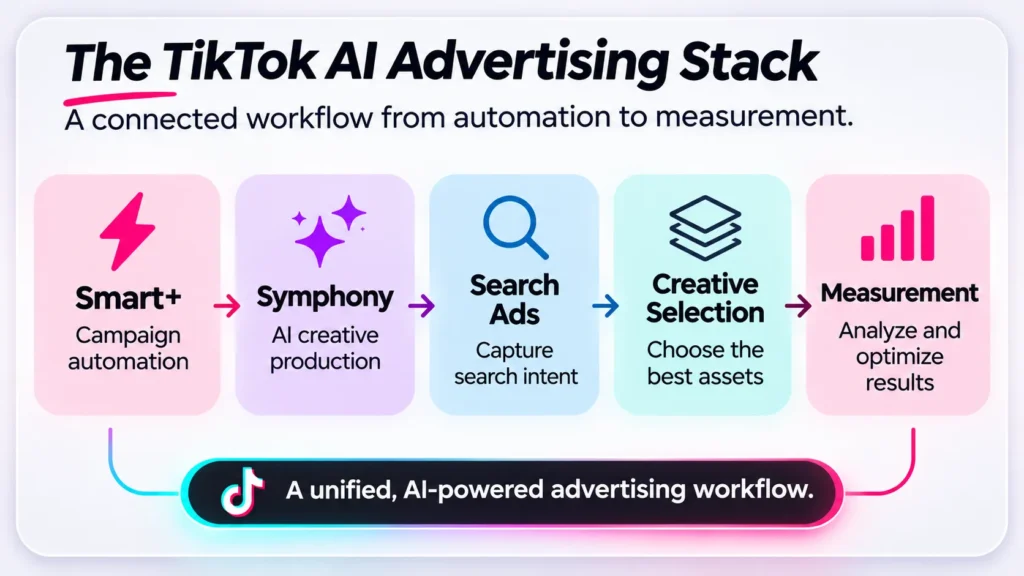
Smart+ is central to TikTok’s current advertising automation strategy.
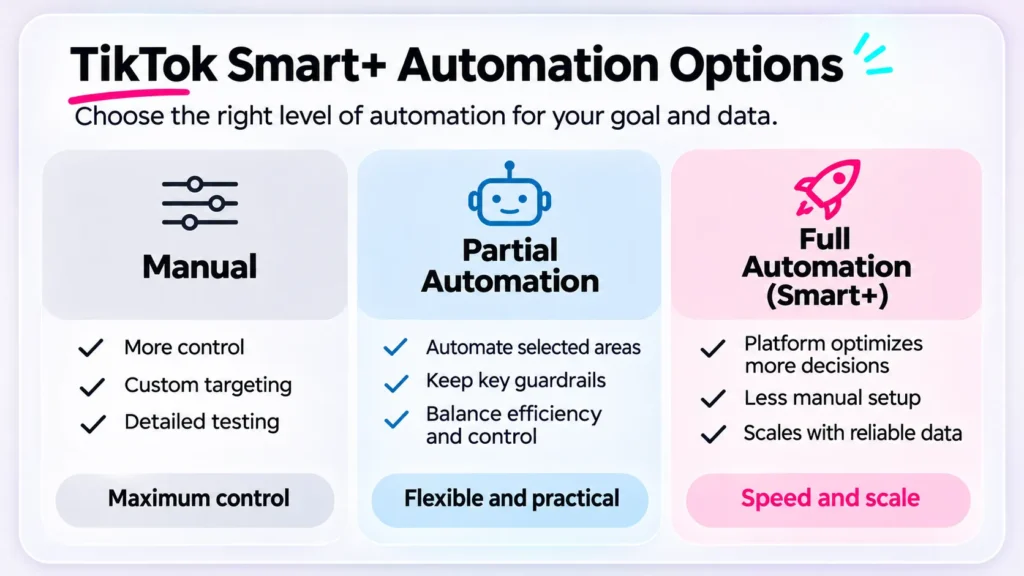
In its upgraded 2026 experience, TikTok has brought manual and Smart+ campaign creation into a more unified workflow. Depending on the objective and feature availability, advertisers can use full automation, partial automation, or more manual control.
This is an important distinction. AI-driven campaign management no longer necessarily means handing every decision to the platform.
A brand may choose to automate one area while keeping tighter control elsewhere.
Smart+ can help automate or assist with areas such as:
- Audience targeting
- Placements
- Budget distribution
- Creative combinations
- Asset recommendations
- Creative enhancements
- Campaign optimization
The upgraded system also gives advertisers more flexibility around campaign structure, multiple ad groups, product sets, destination URLs, and creative assets.
Full Automation Is Not the Only Smart+ Option
One of the more important changes in 2026 is that brands do not necessarily have to choose between completely manual advertising and completely automated advertising.
Smart+ increasingly supports a spectrum of control.
| Approach | How It Works | When It May Be Useful |
|---|---|---|
| Manual | The advertiser controls more targeting, campaign, and creative decisions | When strict audience, placement, testing, or business constraints matter |
| Partial automation | Selected modules use automation while others remain advertiser-controlled | When the brand wants efficiency without giving up important guardrails |
| Full automation | The platform receives broader freedom to optimize campaign components | When conversion data and campaign economics are sufficiently reliable |
The right level depends on the quality of the data and the business objective.
If a brand gives the system more freedom but optimizes toward a low-quality conversion, TikTok can become more efficient at producing the wrong outcome.
Automatic Targeting Changes the Advertiser’s Role
Smart+ can use automatic targeting to identify audiences that the system predicts are most likely to achieve the campaign objective.
Advertisers can still provide controls and suggestions, and TikTok’s current workflow also allows switching toward more custom targeting when greater precision is required.
This changes what audience strategy looks like.
Historically, a performance marketer might spend significant time building interest combinations, demographic segments, device filters, and overlapping audience structures.
As automated targeting improves, more of the advertiser’s value shifts toward:
- Defining the correct conversion event
- Providing reliable first-party signals where appropriate
- Setting geographic or age restrictions that genuinely matter
- Understanding customer economics
- Providing enough creative variation
- Monitoring the quality of conversions
The platform can optimize delivery, but it cannot decide whether a customer is economically valuable unless the advertiser provides useful signals and evaluates the business outcome.
TikTok Symphony Is the Generative AI Creative Layer
TikTok Symphony is the platform’s generative AI creative suite.
Its current 2026 tools can assist with video generation, image generation, scripts, voiceovers, avatars, translation, dubbing, editing, and creative variations.
Symphony Creative Studio can generate new content from text prompts or existing brand assets. It can also transform images into video and use reference material to guide new creative.
TikTok has also integrated newer video-generation models into Symphony to improve motion, product consistency, and consistency across scenes.
For marketing teams, the important implication is creative volume.
Instead of producing one master video and resizing it into several placements, brands can increasingly create multiple concepts, hooks, languages, scenes, and product variations from a larger creative system.
Symphony Agent Moves From AI Tool to AI Workflow
Symphony Agent pushes the concept further.
Rather than asking advertisers to open separate tools for research, ideation, scripting, generation, and refinement, TikTok is building agent-like workflows that can move from a brief toward finished creative.
Within Symphony Creative Studio, advertisers can provide campaign goals, product assets, trends, brand guidelines, or reference material. The system can then assist with:
- Developing a product brief
- Finding relevant creative patterns
- Creating a storyboard
- Generating scripts
- Producing video
- Creating different variations
- Editing voiceovers
- Adjusting calls to action
- Changing scenes or creative direction
This can reduce production time, but it does not remove the need for creative judgment.
An AI system can produce many videos quickly. The marketing team still needs to decide whether those videos communicate a useful customer insight, represent the product accurately, and feel credible for the brand.
AI Is Also Entering Creator Discovery
TikTok’s AI strategy is not limited to synthetic creative.
Symphony Agent also supports creator-related workflows through TikTok One and Content Suite.
Current tools can help brands search large libraries of existing creator content, generate campaign briefs, recommend creators based on campaign requirements, and streamline outreach.
This creates an important distinction in TikTok AI advertising.
The platform is using AI both to generate new content and to find useful human-created content.
That can be valuable because brands do not necessarily need to choose between AI creative and creator creative. A campaign can use brand assets, licensed creator videos, historical ads, and AI-generated variations as parts of the same creative portfolio.
Smart+ Creative Selection Connects Those Creative Sources
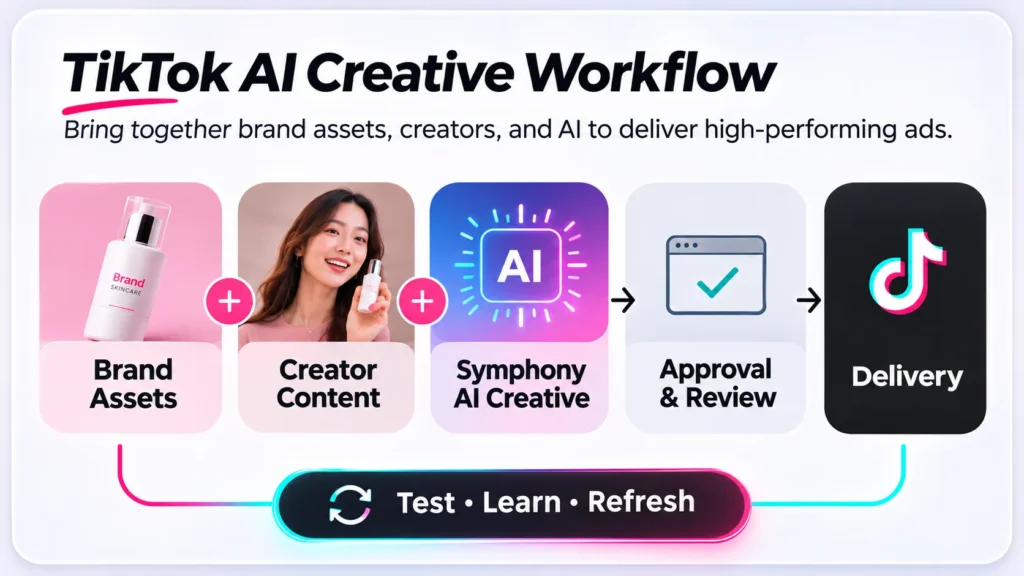
TikTok introduced Smart+ Creative Selection as a way to bring more of those assets into one campaign workflow.
The system can recommend potential creative from sources including:
- Advertiser-owned assets
- Historical brand creative
- Creator content
- AI-generated creative
- Product and catalog assets
The advertiser can then choose how much control to retain.
Brands can manually select assets, allow new recommendations to be added automatically, require approval before recommended creative goes live, or keep the creative pool fixed.
This is strategically important because one of the main constraints in paid social advertising is creative fatigue.
An automated bidding system cannot solve a campaign indefinitely if the audience keeps seeing the same weak or exhausted creative.
TikTok is therefore applying AI not only to media delivery but also to creative supply.
Brands Should Think in Creative Systems, Not Individual Ads
This shift changes how creative teams should plan TikTok campaigns.
Instead of asking for “three new TikTok ads,” a brand can build a creative system containing:
- Different customer problems
- Multiple hooks
- Several product benefits
- Creator content
- Product demonstrations
- UGC-style videos
- Founder or expert content
- AI-generated variations
- Different calls to action
- Different landing-page destinations
The system then has more meaningful options to test.
Creative automation becomes much more useful when the input library contains genuinely different ideas rather than 20 minor edits of the same advertisement.
TikTok Search Ads Are Becoming More Automated
Search is another major area of TikTok AI advertising in 2026.
TikTok now offers dedicated Search Ads Campaigns in eligible markets, allowing advertisers to target keywords and appear within TikTok search results.
The platform is also bringing Smart+ automation into that workflow.
Search Ads powered by Smart+ can assist with keyword and creative automation while advertisers retain keyword, bidding, budget, and negative-keyword controls.
Automated keywords can help campaigns identify additional relevant search queries beyond the advertiser’s initial keyword set.
This reflects TikTok’s larger evolution from a feed-only advertising platform toward a platform that also captures explicit search behavior.
Search Intent and Feed Discovery Should Work Together
TikTok search and TikTok feed advertising serve different moments.
A user scrolling the For You feed may discover a product before actively looking for it. A user searching “best carry-on backpack,” “easy dinner recipe,” or “how to fix dry skin” is expressing more explicit intent.
Brands can therefore think about TikTok advertising across two different behaviors:
Discovery: Reach someone with relevant content before they search.
Intent: Appear when someone actively searches for a related solution or category.
AI can increasingly connect these environments through creative relevance, keyword recommendations, automatic search placement, and campaign optimization.
GMV Max Is Bringing AI Deeper Into TikTok Shop Advertising
For TikTok Shop sellers, GMV Max represents a different type of automation.
Instead of concentrating only on an individual ad or audience, GMV Max automates more of the commerce advertising process around products, content, budgets, and sales performance.
In 2026, TikTok has been expanding that concept with GMV Max Pro.
GMV Max Pro is designed to consider more than media spend alone. TikTok says the system can account for additional commerce costs such as:
- Coupons
- Affiliate costs
- Platform commissions
- Advertising spend
This is an important evolution because gross merchandise value is not the same as profitability.
A campaign can generate high sales while becoming less attractive after discounts, affiliate commissions, advertising spend, and platform costs are included.
The direction of GMV Max Pro suggests that TikTok is attempting to move optimization closer to the economics merchants actually manage.
Growth Autopilot Targets the New-Product Problem
TikTok has also introduced automation designed for products with limited historical data.
Growth Autopilot, within the GMV Max ecosystem, is designed to help merchants launch and scale products during the cold-start period.
The system can combine advertising and coupon budgets while optimizing toward an ROI target over a defined period.
For brands, this illustrates how AI advertising is moving beyond campaign configuration and toward broader commercial decisions.
However, brands should still evaluate whether the platform’s ROI definition matches their internal profitability model.
AI-Generated Calls to Action Are Expanding Too
TikTok is also applying AI to smaller campaign components.
Its Q4 2026 updates include AI-powered CTA enhancements that can generate and serve contextual call-to-action options based on information such as landing-page content and advertising text.
This may sound minor compared with video generation or audience automation, but it demonstrates the direction of the platform.
More campaign elements are becoming dynamic rather than fixed.
Over time, an advertisement may increasingly function as a collection of assets and signals that the system assembles or selects according to the user, context, and business objective.
AI-Generated Ads Still Need Human Review
More automation does not remove advertiser responsibility.
AI can misunderstand a product, create an inaccurate visual detail, overstate a benefit, generate awkward language, or produce a claim that the business cannot support.
Brands should review AI-generated creative for:
- Product accuracy
- Pricing accuracy
- Legal or regulatory claims
- Brand consistency
- Copyright or licensing issues
- Visual errors
- Misleading demonstrations
- Translations and dubbing
- Calls to action
- Local cultural context
Generating more creative increases the need for a strong approval system rather than reducing it.
TikTok Requires Transparency for Significant AI-Generated Content
Brands also need to understand TikTok’s AI-content disclosure rules.
TikTok’s advertising policies allow significantly edited or AI-generated content when it meets applicable requirements, including disclosure through an AI-generated-content label or another clear disclosure mechanism.
Completely AI-generated images, video, or audio and substantial AI manipulation generally fall within the types of content that require disclosure.
Minor changes such as basic color adjustment, lighting correction, background removal, or similar limited edits may be treated differently.
TikTok Ads Manager includes a disclosure workflow for qualifying AI-generated advertising, while Spark Ads follow the disclosure rules applicable to the underlying organic content.
TikTok also states that advertisements may be rejected or restricted when AI-generated content that requires disclosure is not appropriately labeled.
AI Cannot Be Used to Fake Endorsements
Generative AI creates additional risks around identity and likeness.
TikTok’s current advertising rules prohibit misleading misuse of people’s likenesses, including using public figures in false endorsements or presenting people as doing or saying things they did not actually do without appropriate permission.
This is especially important for brands experimenting with AI avatars, synthetic voices, face replacement, or highly realistic generated scenes.
The fact that a tool can technically generate something does not mean the advertiser has the legal or platform permission to use it.
The Biggest Risk Is Automating Bad Inputs
AI advertising systems become more powerful when they receive reliable information.
They also become more dangerous to a budget when the inputs are weak.
Common examples include:
- Optimizing toward low-quality leads
- Using incorrect purchase values
- Sending traffic to weak landing pages
- Providing inaccurate product feeds
- Supplying repetitive creative
- Using broad automation without geographic or commercial guardrails
- Scaling before the business understands customer profitability
Automation can increase the speed of optimization. It cannot guarantee that the optimization goal is economically correct.
Measurement Becomes More Important as Automation Increases
The more decisions the platform makes, the more important independent business measurement becomes.
Brands should review performance at several levels.
| Measurement Layer | Examples | Key Question |
|---|---|---|
| Delivery | Spend, impressions, reach, search coverage | Where is the system allocating media? |
| Creative | Watch behavior, clicks, creative combinations, fatigue | Which assets are earning attention? |
| Conversion | Purchases, leads, installs, registrations | Is the campaign generating the intended action? |
| Acquisition | CPA, CAC, new customers | What does customer acquisition cost? |
| Commerce | Revenue, GMV, discounts, commissions, returns | What economic value is the campaign producing? |
| Business | Margin, retention, lifetime value, profitability | Is automated growth sustainable? |
The platform’s optimization metric and the company’s financial metric do not always answer the same question.
What Should Brands Do With TikTok AI Advertising in 2026?
1. Start With the Business Objective
Do not enable automation merely because it is new. Decide whether the goal is revenue, profitable customer acquisition, leads, app users, TikTok Shop GMV, traffic, or another defined result.
2. Fix Conversion Measurement Before Increasing Automation
Review whether conversion events represent meaningful customer actions. Remove duplicate or misleading signals and verify values where revenue-based optimization is used.
3. Build a Larger Creative Library
Give Smart+ and creative-selection systems meaningful options. Combine brand creative, creator content, UGC-style assets, demonstrations, product videos, and carefully reviewed AI-generated variations.
4. Use AI to Expand Creative, Not Replace Creative Strategy
AI can help generate variations quickly, but the team still needs distinct customer insights, product angles, hooks, objections, and use cases.
5. Decide Where Human Approval Is Necessary
High-risk claims, regulated categories, pricing, product comparisons, creator likeness, synthetic people, and local-language content may require stronger review before publication.
6. Test Search as a Separate Intent Layer
If TikTok Search Ads are available for the relevant market and objective, consider how search behavior complements feed discovery. Build keyword groups around customer problems, products, categories, comparisons, and high-intent questions.
7. Review TikTok Shop Economics Beyond GMV
For commerce campaigns, account for discounts, affiliate commissions, platform costs, returns, and margin rather than judging performance only by top-line sales.
8. Keep Automation Guardrails
Use geographic restrictions, audience controls, negative keywords, approval workflows, product exclusions, budget limits, and other available controls where they reflect genuine business constraints.
9. Treat AI Features as Experiments
Do not assume an automated feature will improve every account. Test against a meaningful baseline and evaluate the business outcome rather than accepting platform recommendations automatically.
10. Recheck Feature Availability
TikTok is rolling out many 2026 features gradually. A tool described in global marketing material may not yet be available for every account, objective, language, or country.
What TikTok’s 2026 AI Push Really Means
The largest change is not that TikTok can generate videos with AI.
The larger shift is that campaign management and creative production are starting to merge.
Historically, teams often worked in separate stages:
strategy → production → media buying → optimization
TikTok’s emerging AI advertising model increasingly looks like:
business goal → asset pool → automated targeting → automated creative selection → delivery → performance signals → creative refresh → optimization
That can make campaigns faster and more scalable, but it also changes where marketers create value.
Manual button-clicking becomes less important. Customer understanding, creative strategy, measurement quality, commercial judgment, and governance become more important.
AI Does Not Eliminate the Need for TikTok-Native Creative
One potential mistake is assuming that better generative AI will make creative quality irrelevant.
The opposite is more likely.
If every advertiser can generate more content, simply producing more videos becomes less of a competitive advantage.
The advantage shifts toward producing content based on better insights:
- A more recognizable customer problem
- A stronger opening hook
- A clearer demonstration
- A more useful creator perspective
- A better offer
- A more convincing proof point
- A more relevant cultural context
AI can accelerate execution. It does not automatically create a stronger reason for someone to care.
FAQ
What is TikTok AI advertising?
TikTok AI advertising refers to the growing use of artificial intelligence across TikTok’s advertising workflow, including Smart+ campaign automation, audience optimization, Search Ads, creative generation through Symphony, creative selection, creator discovery, and TikTok Shop optimization.
What is TikTok Smart+?
Smart+ is TikTok’s performance advertising automation system. In the upgraded 2026 workflow, advertisers can use different levels of automation across targeting, placements, budgets, creative, and other campaign modules depending on objective and availability.
What is TikTok Symphony?
TikTok Symphony is the platform’s generative AI creative suite. Its current tools can assist with video and image generation, scripts, avatars, voiceovers, translation, dubbing, editing, creative variations, and other production tasks.
Can TikTok automatically generate ads?
Yes. TikTok currently provides AI-assisted creative-generation capabilities through Symphony and other Ads Manager tools. Brands should still review generated assets for product accuracy, claims, brand suitability, rights, and applicable AI-content disclosure requirements.
Does TikTok use AI for Search Ads?
Yes. TikTok is integrating Smart+ automation into Search Ads, including features that can help expand keywords and select relevant creative. Advertisers retain keyword and other campaign controls depending on the workflow and feature availability.
Does TikTok require labels on AI-generated advertising?
Significantly AI-generated or AI-modified advertising can require disclosure under TikTok’s advertising policies. TikTok provides AI-content disclosure tools, and undisclosed qualifying AI-generated ads may be rejected or restricted.
Should brands switch every TikTok campaign to full automation?
No. The appropriate level of automation depends on measurement quality, campaign maturity, conversion volume, business constraints, creative supply, and the objective. TikTok’s upgraded Smart+ experience itself supports full, partial, and manual approaches rather than requiring one model for every advertiser.
Final Thoughts on TikTok AI Advertising in 2026
TikTok AI advertising in 2026 is moving beyond isolated automation features toward a connected advertising system. Smart+ can automate campaign decisions, Symphony can expand creative production, Search Ads can capture explicit intent, Smart+ Creative Selection can manage larger asset pools, and GMV Max can automate more of the commerce advertising workflow.
For brands, the opportunity is not to remove people from marketing. It is to spend less time on repetitive campaign operations while putting more attention into customer insight, creative ideas, conversion quality, profitability, and responsible oversight.
The brands most likely to benefit from TikTok’s AI tools will be those that give the systems strong inputs and still maintain clear business judgment about what should be automated, what should be reviewed, and what success actually means.
If your brand needs support connecting TikTok creative, paid media, measurement, and campaign automation into a practical performance strategy, explore Dyna Soul Solutions.


