

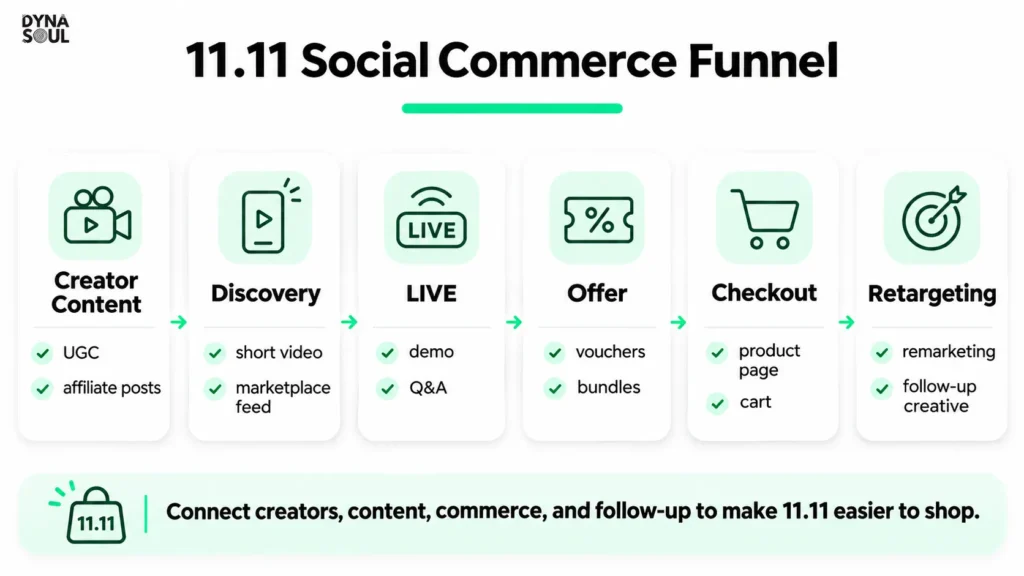
11.11 social commerce marketing is increasingly about more than publishing a discount and waiting for shoppers to arrive. For brands selling through marketplaces and social-shopping platforms, the campaign can now begin with a creator recommendation, continue through short-form video or a livestream, and end with a purchase without the customer ever following a traditional linear advertising path.
That changes how brands should prepare for the event. Price and promotion still matter, but creators, livestream hosts, user-generated content, affiliate partners, product demonstrations, platform offers, inventory, and fulfilment all need to work together.
The most useful way to approach 11.11 is therefore not as a single day of discounting. It is a content-commerce window in which brands can build demand before the peak, answer buying questions in real time, convert high-intent shoppers during the event, and reuse the strongest creative after the sale.
What Is 11.11 Social Commerce Marketing?
11.11 social commerce marketing is the use of creators, social content, livestreams, affiliates, user-generated content, marketplace features, and promotional offers to support sales around the 11 November shopping period.
The difference from a traditional marketplace promotion is that product discovery can happen inside content rather than only through search results or category pages.
A shopper might first encounter a product through:
- A creator’s short-form video
- An affiliate recommendation
- A product demonstration
- A customer review
- A livestream
- A social post
- A marketplace video feed
- A paid advertisement using creator content
The shopper can then move directly toward a product listing, voucher, livestream checkout, or marketplace cart.
This makes creative and commerce much more closely connected.
Why 11.11 Is Becoming a Content-Commerce Event
Large shopping events have traditionally competed heavily on price. That remains important, but the number of offers available during a mega-sale creates another problem: shoppers need help deciding what deserves their attention.
Creators, livestreams, and short-form content can reduce that decision friction by showing products in use, explaining differences, answering questions, and helping customers understand whether a product fits their needs.
Regional social-commerce activity in 2026 also shows how significant content-led shopping has become. Research firm Momentum Works estimates that content commerce, including livestreaming, short video, and content-led affiliate sales, accounted for 37% of Southeast Asian platform e-commerce GMV in the first half of 2026.
The implication for brands is not that every sale must happen through an influencer or livestream. It is that product content is increasingly part of the shopping infrastructure rather than only an awareness tool.
What the 2026 11.11 Season Is Showing
Current 2026 campaigns across Southeast Asia illustrate how platforms and brands are connecting creators with shopping events.
In Singapore, Shopee’s 2026 affiliate programme has become a significant discovery channel, with affiliate-created content contributing to marketplace visits and sales. Ahead of 11.11, Shopee brought creators and brands together to learn about products directly and prepare recommendations for the campaign.
One current 11.11 activation takes the model further. Singapore wellness brand Moom is combining affiliate creators with a long-form Shopee Live campaign: creators produce livestream content before the main sale window, followed by an extended livestream marathon during the peak period.
Lazada is also highlighting creator-led shopping in its 2026 11.11 activity in Malaysia, where product demonstrations, affiliate content, and livestream conversations are being used to help customers compare products and evaluate purchases.
TikTok Shop has been building the same general model around discovery commerce. Its 2026 guidance for Southeast Asian sellers repeatedly connects short-form video, creators, affiliate marketing, and LIVE selling as complementary ways to move shoppers from discovery toward purchase.
These examples point to the same strategic idea: social commerce works best when the creator, content, offer, and checkout experience are connected rather than managed as separate campaigns.
Creators Give 11.11 Campaigns Distribution and Context
Creators can help brands reach audiences before shoppers actively search for the product.
But distribution alone is not the main value. A useful creator can also provide context.
Instead of simply announcing a discount, the creator can explain:
- What the product does
- Who it is useful for
- How it compares with another option
- How it fits into a routine
- Which version or variation to choose
- What problem it addresses
- Why the 11.11 offer may be worth considering
This can be especially valuable for products that need demonstration or explanation before a shopper feels ready to purchase.
Do Not Select Creators Only by Follower Count
For a conversion-oriented 11.11 campaign, audience relevance and product communication can matter more than raw reach.
Review:
- Audience location
- Category relevance
- Recent content performance
- Ability to explain or demonstrate products
- Comment quality
- Experience with commerce content
- Livestream ability where relevant
- Affiliate performance where reliable data is available
A smaller creator who consistently explains products clearly to a relevant audience may be more valuable than a larger creator whose content has little connection to the category.
Affiliate Creators Can Extend the Campaign Beyond Brand-Owned Media
Affiliate commerce gives creators an additional reason to continue recommending products because compensation can be connected to trackable sales or other qualifying actions.
For brands, this can create a broader network of content around the 11.11 offer.
However, an affiliate programme still requires management. Brands should give creators accurate product information, clear campaign dates, stock visibility where possible, correct links, approved promotional terms, and understandable commission rules.
The strongest affiliate relationships are not built by sending a generic product list to hundreds of creators and hoping for coverage. Creators need enough information to make credible recommendations in their own voice.
Livestreams Turn Shopping Questions Into Real-Time Content
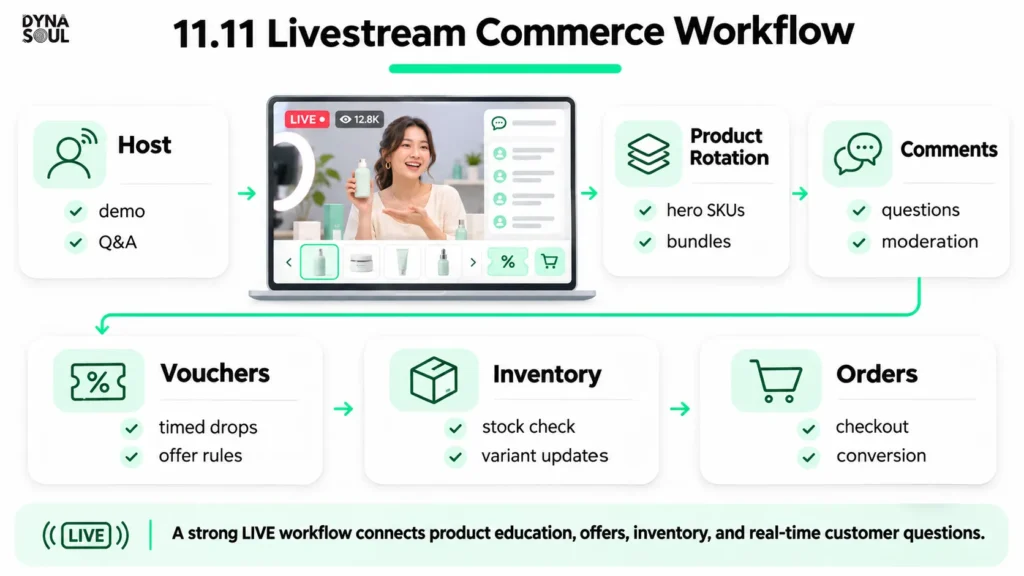
Livestream commerce plays a different role from a short video.
A short-form video may introduce the product in seconds. A livestream can spend much longer answering the questions that prevent purchase.
During a LIVE session, hosts can:
- Demonstrate the product repeatedly
- Compare variants
- Answer questions from comments
- Explain sizing, ingredients, features, or compatibility
- Show bundles
- Introduce timed vouchers
- Respond to objections
- Repeat key information for new viewers entering the stream
This makes livestreaming especially useful when customers need reassurance or education before checkout.
TikTok Shop reported in Malaysia in 2026 that almost six in 10 of its users there chose LIVE shopping as their preferred shopping format, while LIVE sales had grown year over year and represented a substantial share of platform sales.
That does not mean every brand needs an all-day broadcast. It does show why livestreaming deserves to be considered as a core commerce format rather than simply an entertainment experiment.
Build the Livestream Around Customer Decisions
A successful 11.11 livestream needs more structure than putting a host in front of a camera and asking them to talk about products.
Build a run-of-show around customer questions.
A simple structure might include:
- Opening offer and reason to stay
- Hero-product demonstration
- Common customer question
- Product comparison
- Bundle or voucher explanation
- Audience Q&A
- Next hero product
- Limited-time reminder
- Customer proof or use case
- Final offer recap
Longer streams can repeat this pattern because viewers enter at different times.
Prepare the Host With More Than a Script
Hosts should understand the products well enough to respond when the conversation moves beyond prepared talking points.
Give them:
- Product facts
- Demonstration instructions
- Pricing and voucher rules
- Available variants
- Stock limitations
- Frequently asked questions
- Claims they should avoid
- Shipping information
- Comparison guidance
- Escalation instructions for questions they cannot answer
The better the product knowledge, the less the livestream feels like someone reading an advertisement.
UGC Gives the Campaign More Creative Surface Area
User-generated content can support 11.11 in several ways.
Brands may already have genuine customer content such as reviews, demonstrations, unboxings, or product experiences. They can also commission UGC-style videos from creators specifically for the campaign.
The distinction matters because permissions and commercial relationships are different, but both formats can help communicate product value in a more social-native way.
Useful 11.11 UGC formats include:
- Product demonstrations
- Before-and-after use cases where claims are supportable
- Unboxings
- “What I bought” videos
- Gift guides
- Product comparisons
- Problem-solution videos
- FAQ videos
- Customer testimonials
- Bundle explainers
- “What to buy during 11.11” roundups
UGC Should Start Before 11 November
Waiting until the peak day to publish everything creates unnecessary pressure.
Customers may begin researching products, building carts, comparing sellers, following creators, and checking upcoming offers before the main promotion begins.
That creates a useful pre-heat period.
Pre-sale content can focus on:
- Problem awareness
- Product education
- Demonstrations
- Reviews
- Gift or shopping lists
- “Save this for 11.11” content
- Upcoming bundle previews
- Livestream announcements
- Product comparisons
The peak period can then shift toward urgency, availability, bundles, vouchers, livestreams, and direct conversion.
A Three-Phase 11.11 Social Commerce Marketing Plan
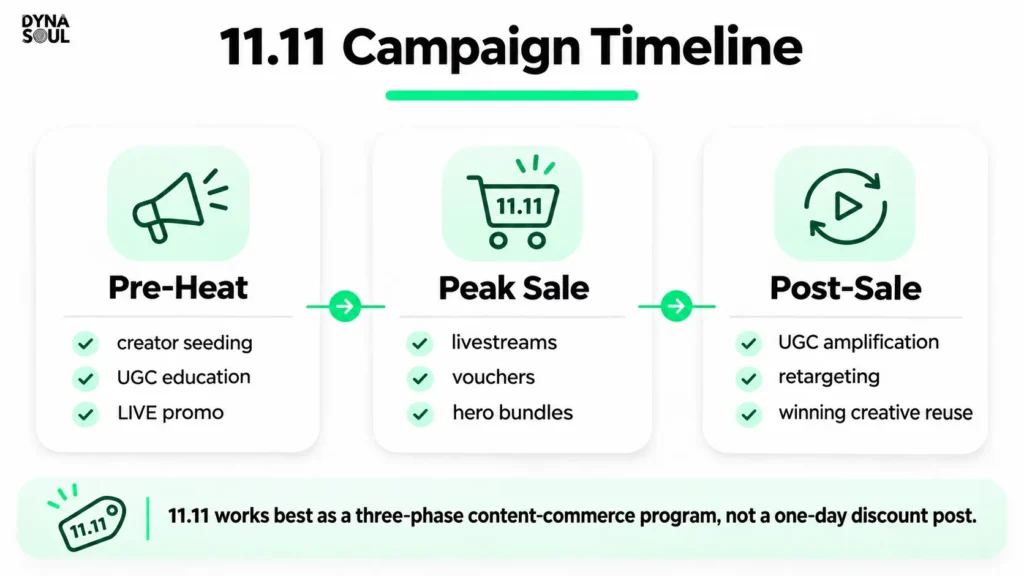
Phase 1: Pre-Heat
The goal of the pre-heat period is to build product familiarity before the most competitive hours of the event.
Brands can:
- Seed products to creators
- Publish educational UGC
- Release product demonstrations
- Promote upcoming livestreams
- Build affiliate content
- Encourage shoppers to save products
- Introduce hero products and bundles
- Test hooks and creative angles
This is also the best period to identify which content should receive more distribution during the peak.
Phase 2: Peak Sale
During the peak period, content should make buying easier.
Prioritize:
- Livestream demonstrations
- Creator reminders
- Clear voucher explanations
- Limited-time bundles
- Product comparisons
- Inventory-aware recommendations
- High-performing UGC
- Paid amplification where economics support it
Operational coordination matters most here. A creator should not continue promoting an item that is unavailable, and hosts should understand when an offer, voucher, or product variation changes.
Phase 3: Post-Peak
The campaign should not disappear immediately after midnight.
Post-11.11 activity can include:
- Retargeting interested shoppers where appropriate
- Promoting remaining campaign offers
- Repurposing strong creator content
- Publishing customer reactions
- Reviewing winning products
- Following up with new customers
- Turning campaign FAQs into evergreen content
- Preparing winning concepts for 12.12 or holiday campaigns
A useful 11.11 campaign should create both revenue and creative learning.
Offer Architecture Matters as Much as Creative
Strong creative can attract attention, but customers still need to understand the deal.
Complicated promotions create friction.
Brands should make clear:
- What is discounted
- When the offer starts and ends
- Whether the deal requires a voucher
- Minimum spend where relevant
- Which bundles are exclusive
- Whether free shipping applies
- Whether a livestream-only offer exists
- Whether stock is limited
Creators and livestream hosts should receive the same information as the e-commerce team so customers do not hear conflicting terms.
Do Not Separate Content Planning From Inventory Planning
One of the most expensive mistakes in social commerce is putting strong media behind a product the business cannot fulfil.
Before the peak period, coordinate:
- Inventory
- Hero products
- Bundles
- Pricing
- Vouchers
- Creator links
- Affiliate commissions
- Fulfilment capacity
- Customer support
- Returns or cancellation processes
If an item sells out, the content team needs a replacement product or updated message quickly.
Social commerce connects marketing more directly to operations than a traditional awareness campaign because the distance between content and checkout can be very short.
Use Paid Media to Amplify Proven Creative, Not Replace It
Paid amplification can help strong creator and UGC assets reach more shoppers during the limited sale window.
But media spend should not be used to compensate for weak creative or an unclear offer.
A more disciplined approach is:
- Produce several creator and UGC concepts.
- Observe early performance.
- Identify useful messages, hooks, and products.
- Secure the necessary usage rights.
- Amplify selected assets where campaign economics support additional spend.
This allows organic, creator, affiliate, and paid-media activity to share learning rather than operating in separate silos.
How to Measure an 11.11 Social Commerce Campaign
The campaign should be measured at several levels.
| Measurement Area | Examples | What It Helps Answer |
|---|---|---|
| Content | Views, watch behavior, saves, shares, clicks | Which creative earns attention? |
| Creator | Qualified traffic, affiliate clicks, attributed orders, content quality | Which creators generate useful commercial activity? |
| Livestream | Viewers, viewing time, product clicks, questions, orders | Which products and host segments move viewers toward purchase? |
| Commerce | Orders, conversion rate, average order value, revenue | Did campaign traffic convert? |
| Customer | New customers, repeat behavior, cancellations, returns | What kind of customer did the event acquire? |
| Business | Margin, acquisition cost, blended efficiency | Was the event economically valuable? |
Gross merchandise value or revenue alone should not be the final measure. Large discounts, commissions, creator fees, media spend, fulfilment costs, and returns can change the business value of the campaign.
Measure Creators Beyond Last-Click Sales
Affiliate sales are useful because they provide a relatively direct commercial signal, but not every creator interaction will end with a customer purchasing through the original link.
A shopper may watch a creator’s video, enter a livestream later, search for the brand inside the marketplace, and then complete the purchase from the product page.
Where data allows, brands should consider creator performance using several indicators:
- Content quality
- Relevant reach
- Clicks
- Affiliate conversions
- New-customer contribution
- Livestream participation
- Reusable creative value
- Performance of licensed creator content in paid media
This creates a better picture of contribution than using follower count or direct sales alone.
A Practical 11.11 Social Commerce Workflow
- Choose the products and commercial objective.
- Confirm inventory, fulfilment capacity, and offer structure.
- Select hero products and bundles.
- Recruit relevant creators and affiliates.
- Build UGC concepts around customer questions and use cases.
- Prepare short-form content for the pre-heat period.
- Create livestream scripts, product rotations, and FAQ resources.
- Confirm creator links, commission rules, vouchers, and tracking.
- Launch pre-heat content and identify promising creative.
- Increase creator, LIVE, and paid activity during peak windows.
- Monitor stock, comments, customer questions, and conversion performance in real time.
- Reuse winning content and campaign learning after 11.11.
Common 11.11 Social Commerce Marketing Mistakes
Starting the Campaign on 11 November
By the peak day, many shoppers are already comparing products and preparing carts. Discovery and education should begin earlier.
Using Creators Only to Announce Discounts
A creator can do more than read a promotional message. Product education, demonstrations, comparisons, and real use cases often give the audience more reason to care about the offer.
Running Livestreams Without Product Knowledge
Hosts who cannot answer basic product questions create friction instead of reducing it.
Using One Piece of UGC Everywhere
Different customers respond to different problems, benefits, formats, and creators. A portfolio of creative provides more learning and more opportunities to find a strong message.
Promoting Products Without Checking Inventory
Social commerce can create demand quickly. Marketing, e-commerce, and operations teams need a shared view of availability.
Making the Offer Too Complicated
If shoppers need several minutes to understand which voucher, bundle, payment method, or time window applies, the promotion itself becomes conversion friction.
Looking Only at Revenue
A large sales figure can hide low margin, high commissions, expensive media, returns, or excessive discounting. Review the economics of the campaign as well as the top-line result.
What Brands Can Learn After 11.11
The value of 11.11 is not limited to the orders generated during the campaign.
The event can reveal:
- Which creators understand the product best
- Which customer questions appear repeatedly
- Which products are easiest to demonstrate
- Which hooks generate attention
- Which livestream segments drive product clicks
- Which UGC concepts convert
- Which bundles increase order value
- Which objections prevent purchase
- Which operational issues limit scale
Those insights can feed directly into 12.12, year-end campaigns, evergreen advertising, product pages, creator briefs, and future livestream programming.
FAQ
What is 11.11 social commerce marketing?
11.11 social commerce marketing combines e-commerce promotions with creators, affiliates, livestreams, short-form video, UGC, social platforms, and marketplace features to help shoppers discover, evaluate, and purchase products during the 11 November shopping period.
Why are creators important for 11.11?
Creators can introduce products before shoppers actively search, demonstrate how products work, answer common objections, and direct relevant audiences toward marketplace offers. Affiliate arrangements can also connect part of creator compensation with attributable sales.
Should brands use livestreams for 11.11?
Livestreaming can be valuable when customers benefit from demonstrations, comparison, questions, or real-time offer explanations. It is not mandatory for every brand, but it can shorten the path between product education and checkout in suitable categories.
What type of UGC works during 11.11?
Useful formats include demonstrations, unboxings, testimonials, gift guides, comparisons, FAQ videos, bundle explainers, problem-solution content, and “what to buy” recommendations. The best format depends on what the shopper needs to understand before purchasing.
When should an 11.11 campaign start?
Brands should generally begin discovery and educational activity before the peak sale date. The exact timing depends on the platform and campaign, but pre-heat content gives creators and customers time to understand products before the most competitive promotional period.
How should brands measure 11.11 performance?
Measure content attention, creator activity, livestream performance, traffic, orders, conversion, customer acquisition, revenue, margin, and other relevant business outcomes. The strongest analysis looks beyond gross sales to determine whether the event created economically valuable customers and reusable creative learning.
Final Thoughts on 11.11 Social Commerce Marketing
11.11 social commerce marketing works best when creators, livestreams, UGC, offers, paid media, and marketplace operations are treated as parts of the same customer journey. Creators can create discovery, short-form content can build understanding, livestreams can answer buying questions, and marketplace offers can convert attention while intent is high.
The brands that learn the most from 11.11 will not only ask how much they sold. They will identify which creators, messages, products, formats, and customer questions should influence their next campaign.
If your brand needs support connecting e-commerce campaigns, creators, UGC, livestreaming, and paid media into a coordinated social-commerce program, explore Dyna Soul Solutions.


