
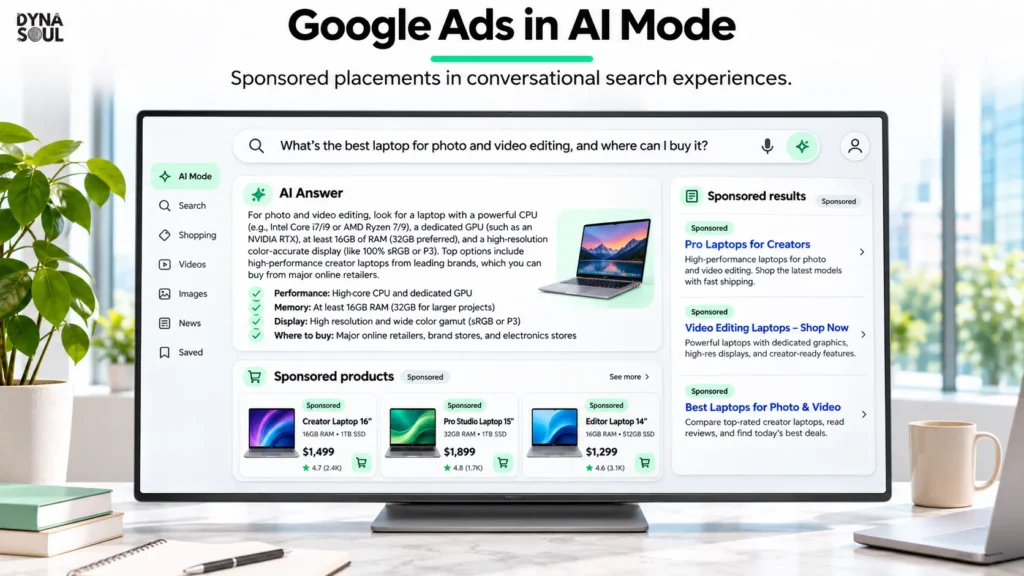
Google Ads in AI Mode moved into a new phase in October 2026. Google expanded sponsored placements in its conversational search experience to 10 additional countries and introduced multiturn advertising in the United States, giving ads the ability to appear as a user’s search develops through follow-up questions.
For brands, this is more important than the arrival of another ad placement. AI Mode changes the structure of search itself. People can ask longer questions, provide more context, refine what they want over several turns, and move from broad research to commercial intent without starting a completely new search.
That creates a different advertising environment. Keywords still matter, but Google increasingly has more context about what a person is trying to accomplish, what the AI response has already explained, and when a product or service becomes relevant to the conversation.
This guide explains what changed in the October expansion, how sponsored placements work in AI Mode, and how businesses should think about paid search as Google moves further into AI-powered discovery.
What Changed With Google Ads in AI Mode in October 2026?
On October 28, 2026, Google announced that it was scaling ads in AI Mode to 10 additional markets:
- Australia
- Canada
- India
- Kenya
- Malaysia
- New Zealand
- Nigeria
- Pakistan
- Philippines
- Singapore
Google also said it planned further expansion during Q4 2026, including Brazil, Mexico, and the United Kingdom.
At the same time, Google announced multiturn ads in the United States. This allows sponsored placements to appear during follow-up questions inside an ongoing AI Mode conversation rather than being limited to the first query.
That changes the opportunity for advertisers because commercial intent does not always appear at the beginning of a search journey.
Why Conversational Search Changes Advertising Intent
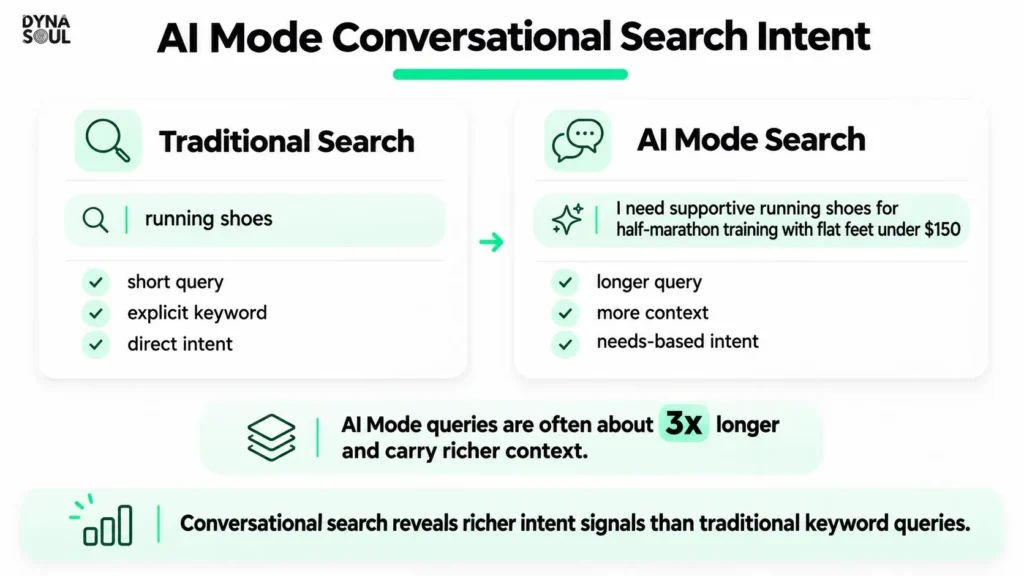
Traditional search advertising often begins with a relatively compact query. Someone searches for a product, service, category, or problem, and advertisers compete to appear against that query.
AI Mode can create a much richer interaction.
Google says AI Mode queries are, on average, three times longer than traditional Search queries. Instead of typing a short phrase, users can explain their circumstances, constraints, preferences, and goals in more detail.
Consider the difference between these searches:
Traditional search: “best running shoes”
Conversational search: “I need running shoes for three short runs a week, mostly on pavement, but I sometimes get knee discomfort and I do not want anything too heavy.”
The second query contains much more context. It reveals frequency, surface, a physical concern, and a product preference.
The person may then continue:
- “Which type of cushioning should I look for?”
- “What if I also use them for walking?”
- “Which options are under my budget?”
- “Are any of these available near me?”
Commercial intent can become clearer with every follow-up.
What Are Multiturn Ads in AI Mode?
Multiturn advertising allows Google to introduce sponsored options as a conversation develops.
A user might begin with a research question that contains little direct purchase intent. After reading the AI response, the user can ask follow-up questions that reveal a specific need, price range, feature requirement, location, or product category.
When the conversation reaches a commercially relevant point, Google can surface an eligible sponsored placement.
This creates an important change in how brands should think about search intent. A query does not always need to begin with “buy,” “price,” “near me,” or a product name for advertising relevance to emerge.
Commercial intent can develop during the conversation.
Where Do Sponsored Placements Appear in AI Mode?
Google says ads can appear directly within or alongside AI-generated responses when a conversation has commercial relevance. These placements are visually distinguished from organic content and labeled Sponsored.
Eligible formats currently include text ads and Shopping ads. Google is also testing additional advertising experiences across its AI-powered search surfaces.
Standard Search ads can continue to appear elsewhere on the results page as well. AI Mode advertising therefore does not replace the existing Search auction; it extends where eligible campaigns can participate.
Brands Do Not Create a Separate “AI Mode Campaign”
One of the most important practical points is that AI Mode is not currently a separate campaign type.
Google says existing eligible:
- Search campaigns
- Shopping campaigns
- Performance Max campaigns
can participate automatically in the auction for relevant placements inside AI-powered Search experiences.
Advertisers do not need to create a separate AI Mode budget.
They also cannot currently target AI Mode exclusively or opt out of AI Mode independently while keeping the rest of Search unchanged.
That means brands should think of AI Mode as an evolving part of Google Search distribution rather than as an entirely separate advertising channel.
How Google Matches Ads to Conversational Searches
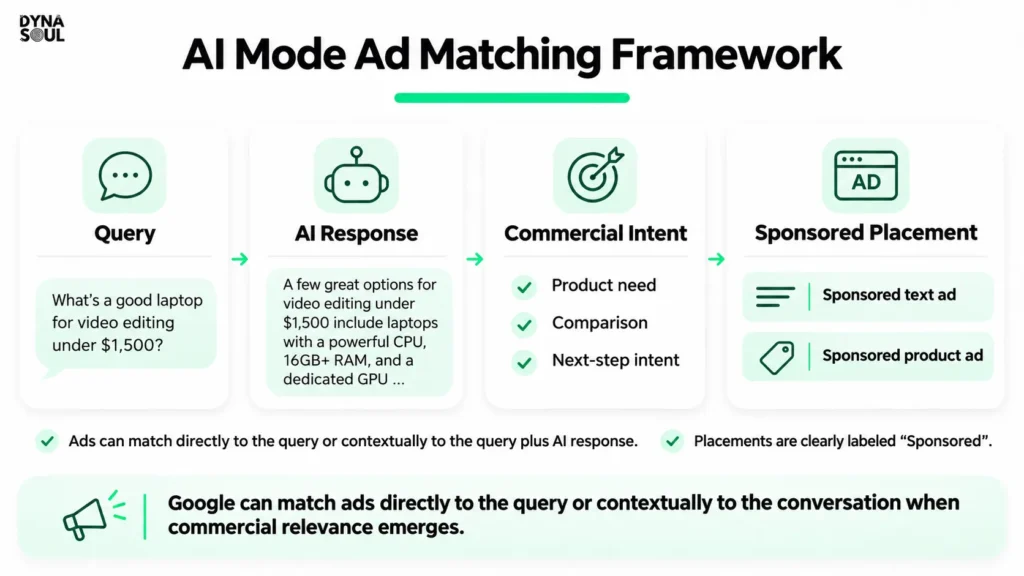
The biggest strategic change is how Google can interpret commercial relevance.
Google describes two broad matching situations.
Direct Query Matching
This resembles traditional paid search. The user’s query already contains clear commercial intent, so an ad can be matched directly to the search.
For example:
“pool vacuum cleaners”
The product category is explicit, making the commercial meaning relatively straightforward.
Contextual Matching
AI Mode also creates situations where the initial question is exploratory rather than directly transactional.
Google provides an example of someone asking why their pool is green and how to clean it. The AI response may explain steps such as water testing, brushing, treatment, and vacuuming. At that point, products such as algae treatments or pool-cleaning equipment can become relevant even though the original query was not explicitly a shopping search.
In these cases, Google can use both the original query and the context of the AI-generated response to determine whether an eligible advertisement is helpful.
This is a significant shift from thinking only in terms of a direct keyword-to-ad relationship.
Exact and Phrase Match Still Matter, but They Do Not Cover Every AI Mode Opportunity
Google’s current guidance distinguishes between traditional keyword matching and AI-powered contextual matching.
Exact and phrase match keywords can still participate when the query expresses direct commercial intent.
However, Google says AI-powered targeting approaches can also participate in contextual matching when commercial relevance emerges from a broader exploratory conversation.
Those approaches include:
- AI Max for Search campaigns
- Broad match in Search
- Shopping campaigns
- Performance Max
This does not mean brands should immediately remove all keyword controls or move every campaign to the broadest possible targeting.
It means advertisers should understand that some future Search opportunities may come from intent Google interprets across the conversation rather than from a direct lexical match to a keyword list.
AI Mode Makes Landing Pages More Important, Not Less
As search becomes more contextual, Google’s systems need more information about what a business actually offers.
A weak landing page that says very little about product use cases, specifications, service areas, pricing logic, customer needs, or differentiators gives both users and automated systems less context.
Brands should make important commercial information easy to understand.
That can include:
- Clear product or service descriptions
- Detailed features and benefits
- Use cases
- Pricing or pricing context where appropriate
- Availability
- Shipping information
- Returns or cancellation policies
- Customer questions
- Product specifications
- Relevant supporting content
The objective is not to write pages for an AI crawler instead of a customer. Good structured information helps both.
Product Feeds Become More Strategically Important for E-commerce
For retailers, Merchant Center data can play an increasingly important role in AI-powered Shopping experiences.
Google’s current guidance recommends maintaining complete and accurate product feeds with descriptive titles and descriptions, current prices, strong product imagery, ratings where available, and clear shipping and return information.
This matters because conversational searches can contain highly specific product requirements.
A shopper may not simply ask for “office chairs.” They may ask for a chair suitable for a small apartment, long working sessions, a particular price range, and a preference for a certain material.
The more accurate and detailed the product information, the better the system can understand whether the item is relevant to that need.
AI-Generated Explainers Introduce a New Layer Between the Ad and the User
Google is also experimenting with AI-generated explainers around sponsored placements.
These are short pieces of context generated by Google’s Gemini models to explain why a product, service, or group of sponsored options may be relevant to the user’s request.
They are separate from an advertiser’s own headline and description.
According to Google’s current documentation, advertisers cannot manually write, edit, approve, or separately opt out of these AI explainers.
That creates a new creative reality for brands. Advertisers still control important inputs such as campaign assets, landing pages, product data, and account settings, but they do not control every sentence a user may see around the sponsored placement.
This increases the importance of accurate website content and product information because Google’s systems can use publicly available information to understand and explain relevance.
AI Mode Does Not Mean Keywords Are Dead
The expansion has already produced predictable claims that traditional search advertising is disappearing. That conclusion is premature.
People still perform direct commercial searches. Exact and phrase match still have a role. Search terms still provide useful information. Negative keywords and brand exclusions remain relevant controls.
What is changing is the range of search behavior that can lead to an advertising opportunity.
Brands should therefore think less in terms of replacing keywords and more in terms of expanding the intent model.
Traditional search intent might look like:
query → keyword match → ad
AI-powered conversational intent can increasingly look like:
question → AI explanation → follow-up → clarified need → commercial relevance → sponsored option
Both can exist at the same time.
Conversion Data Becomes Even More Important
When targeting becomes more automated, the quality of the signals used for optimization becomes more important.
Google currently recommends pairing AI-powered targeting with conversion- or value-based Smart Bidding supported by reliable conversion measurement.
For brands, this means reviewing whether the campaign is optimizing toward the right outcome.
A lead-generation business should ask whether every recorded lead has similar value. An e-commerce company should consider whether purchase value is captured accurately. Businesses with offline sales should evaluate whether qualified leads or completed transactions can be connected back to advertising where appropriate.
Giving an automated system more targeting flexibility while feeding it weak conversion data can simply automate the wrong objective faster.
Do Not Treat AI Mode as a Reason to Abandon Search Discipline
AI-powered distribution increases the importance of good account fundamentals.
Brands should continue to monitor:
- Search terms
- Negative keywords
- Brand exclusions where relevant
- Conversion quality
- Landing-page relevance
- Budget allocation
- Product-feed accuracy
- Creative assets
- Geographic targeting
- Business profitability
The technology may become more automated, but the advertiser still needs to define what good performance means.
Measurement Is Still a Limitation
AI Mode currently creates a measurement challenge for advertisers because it is not operated as a completely separate campaign environment.
Brands should not assume they will always be able to isolate every AI Mode impression, click, conversion, or placement into a clean standalone performance report.
This makes it important to avoid inventing precision that the platform does not currently provide.
Instead, businesses should monitor broader Search performance, search-term quality, conversion trends, campaign mix, landing-page behavior, and any reporting improvements Google releases as AI Mode develops.
For larger advertisers, controlled experiments and broader business-level measurement may become increasingly important when platform-level attribution cannot answer every question.
What Should Brands Do Now?

1. Do Not Build a Separate “AI Mode Strategy” in Isolation
AI Mode is becoming part of Search itself. Start by strengthening the overall Search account rather than treating conversational advertising as a disconnected channel.
2. Audit Conversion Measurement
Make sure campaigns are optimizing toward meaningful business actions. Review duplicate conversions, low-value events, lead quality, purchase values, and offline outcomes where relevant.
3. Improve Landing-Page Information
Make pages genuinely informative. Explain what the product or service does, who it is for, important specifications, use cases, limitations, availability, and relevant commercial details.
4. Improve Product Feeds
E-commerce brands should review Merchant Center titles, descriptions, imagery, pricing, availability, shipping, returns, and product attributes.
5. Evaluate AI-Powered Targeting Deliberately
Understand where AI Max, broad match, Shopping, or Performance Max can extend eligibility into contextual matching. Test changes with clear business objectives rather than enabling automation simply because it is new.
6. Keep Negative Controls Where They Matter
Automation does not eliminate the need to identify irrelevant traffic, unwanted brand associations, or search areas that do not fit the business.
7. Build More Complete Creative Inputs
Strong headlines, descriptions, images, product data, and landing pages give Google’s systems a stronger set of inputs from which to determine relevance.
8. Watch the Rollout by Market
Businesses operating internationally should pay particular attention to where AI Mode advertising becomes available. The October expansion added 10 markets, and Google has already indicated that further geographic expansion is planned.
What the October Expansion Really Signals
The most important lesson is not that Google has found another place to display an advertisement.
The October expansion shows that Google is building advertising into a version of Search where users can express much more complex intent.
Traditional search advertising often works because someone condenses their intent into a few words. AI Mode gives them permission to do the opposite: explain the whole situation.
For advertisers, that can create richer signals about what customers need. But it also gives Google’s systems more responsibility for interpreting when a commercial option should appear.
That trade-off means brands may gain access to more nuanced intent while giving up some of the direct placement control they are used to.
What to Watch Next
Several areas deserve close attention as Google continues developing AI-powered search advertising.
- Expansion into additional countries and languages
- More detailed placement and performance reporting
- Additional controls for AI Mode traffic
- New conversational ad formats
- Changes to AI-generated ad explainers
- Growth of multiturn sponsored placements
- New Shopping and offer-based experiences
- How AI Max reporting evolves
- How product feeds influence conversational commerce
- How advertisers measure incremental value from AI-led searches
Brands should expect the product to change. The best response is not to rebuild strategy around every individual announcement, but to strengthen the data, content, measurement, and commercial fundamentals that make a business understandable to both customers and automated systems.
FAQ
What are Google Ads in AI Mode?
Google Ads in AI Mode are sponsored placements that can appear within or alongside Google’s conversational AI-powered Search experience when a user’s question or conversation has commercial relevance. They are clearly labeled as Sponsored.
What changed in October 2026?
On October 28, Google announced the expansion of ads in AI Mode to Australia, Canada, India, Kenya, Malaysia, New Zealand, Nigeria, Pakistan, the Philippines, and Singapore. Google also launched multiturn ads in the United States and announced plans for additional Q4 expansion.
Do advertisers need a separate AI Mode campaign?
No. Google currently says eligible Search, Shopping, and Performance Max campaigns can automatically participate in AI-powered Search ad auctions when relevant. Advertisers do not create a separate AI Mode campaign or budget.
Can brands target only AI Mode?
No. Google currently does not allow advertisers to target AI Mode exclusively or opt out of it separately from the broader eligible Search experience.
How are ads matched to conversational searches?
Ads can be matched directly when the query already contains clear commercial intent or contextually when commercial relevance emerges from the user’s question and the AI-generated response. Google’s AI-powered targeting systems can participate in these broader contextual matches.
Are AI Mode ads charged differently?
Google currently says AI Mode and AI Overview ads use the same underlying auction and cost-per-click or conversion-based bidding approaches as standard Google Search advertising. There is no separate participation fee for AI Mode.
Are sponsored placements clearly identified?
Yes. Google states that advertisements within its AI-powered Search experiences are visually distinguished from organic AI responses and labeled Sponsored.
What should businesses prioritize for AI-powered search advertising?
Brands should prioritize accurate conversion measurement, strong landing-page information, high-quality product feeds where relevant, useful campaign assets, intentional use of AI-powered targeting, and ongoing search-term and business-performance monitoring.
Final Thoughts on Google Ads in AI Mode
Google Ads in AI Mode should not be viewed simply as a new placement to add to a media plan. The larger change is that paid search is beginning to operate inside longer, more contextual conversations where purchase intent can emerge gradually rather than appearing in the first query.
Brands that adapt well will still need the fundamentals that have always mattered: a useful product, clear positioning, accurate measurement, relevant landing pages, strong commercial data, and disciplined budget decisions. What changes is how Google can interpret and connect those signals to a customer’s evolving search intent.
If your brand needs support adapting paid search strategy, measurement, and campaign structure for a more AI-driven search environment, explore Dyna Soul Solutions.


