

Influencer marketing costs can be difficult to compare because a creator’s quoted fee is only one part of the total campaign budget. A brand may also need to pay for usage rights, exclusivity, product and shipping, campaign management, paid amplification, production, tracking, and other operational costs.
That is why two creators with similar follower counts can quote very different amounts and both may still be reasonable. The price can change based on audience quality, content format, creator demand, production effort, licensing terms, campaign duration, and how the brand plans to use the content after it is published.
This guide explains how influencer marketing costs are structured, what usually changes a creator’s fee, how usage rights affect pricing, and how brands can build a campaign budget without relying on a simplistic price-per-follower formula.
What Do Influencer Marketing Costs Include?
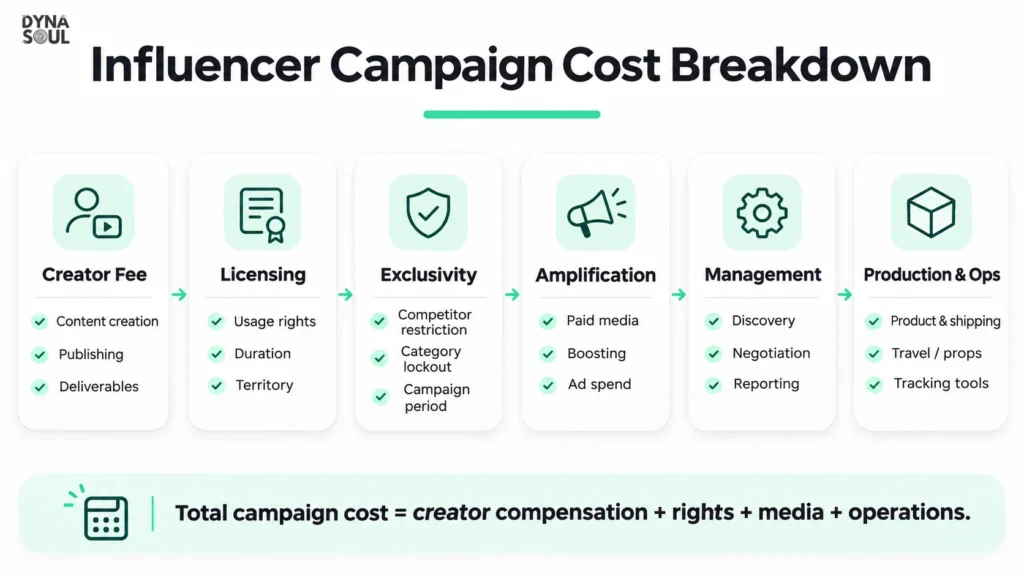
Influencer marketing costs usually include more than the payment made to individual creators. A useful budget separates the different components so the brand can see what it is actually buying.
| Cost Component | What It Covers |
|---|---|
| Creator fee | Payment for agreed content creation, publication, or both |
| Usage rights | Permission for the brand to reuse creator content beyond the original post |
| Exclusivity | Compensation for restricting the creator from working with defined competitors |
| Paid amplification | Media spend used to extend creator content through advertising |
| Product and fulfilment | Samples, gifting, shipping, taxes, customs, or logistics where relevant |
| Production | Locations, travel, props, crew, specialist editing, or other production requirements |
| Campaign management | Creator discovery, outreach, negotiation, briefing, approvals, coordination, and reporting |
| Technology and measurement | Creator-management platforms, affiliate tracking, reporting, payments, or analytics tools |
The creator fee is therefore not the same thing as the campaign budget. A low creator quote can still become an expensive partnership if the brand requires broad licensing, exclusivity, multiple revisions, paid advertising rights, and additional deliverables.
How Creator Fees Are Usually Structured
There is no universal rate card for influencer marketing. Creator compensation can be structured in several ways depending on the campaign objective, the creator’s leverage, and the level of risk each side is taking.
Flat Fee
A flat fee pays the creator an agreed amount for a defined package of deliverables. The agreement might include one short-form video, several Stories, a static post, a YouTube integration, or a multi-format package.
This model is easy to budget because the brand knows the base cost before the campaign begins. The main challenge is making sure the deliverables and commercial rights are clearly defined.
Affiliate or Commission Model
Under an affiliate model, compensation is tied to trackable actions such as sales, leads, or other conversions. The creator may receive a percentage of revenue or another agreed commission.
This can align compensation with performance, but the brand still needs clear rules for attribution, refunds, cancellations, code sharing, and how long a conversion remains attributable to the creator.
Hybrid Fee Plus Commission
A hybrid model combines guaranteed compensation with performance upside. The creator receives a base fee for producing and publishing the content, then earns additional commission when the campaign generates trackable results.
This can balance the creator’s production risk with the brand’s desire for performance incentives.
Product Seeding or Gifting
Some brands provide products without guaranteeing a paid post. This can be useful for relationship building or product sampling, but gifting should not be treated as guaranteed media unless publication is explicitly agreed.
Product, fulfilment, and shipping still have a real cost. In addition, receiving free or discounted products can create a material connection that may require disclosure depending on the market.
Retainer or Ambassador Agreement
Longer-term partnerships can use recurring monthly or quarterly payments for an agreed content schedule, exclusivity terms, appearances, affiliate activity, or other responsibilities.
Retainers can improve planning for both sides and may reduce the need to renegotiate every individual post, but the agreement should still define deliverables, rights, performance review, renewal, and cancellation terms.
What Determines an Influencer’s Base Fee?
Follower count is one input, but it is not a reliable pricing formula by itself. Two creators with similar audience sizes may have very different value to the same brand.
Audience Size and Reach
Larger creators can offer broader potential distribution, which can increase the price. However, actual recent reach can matter more than follower count when the creator’s content performance varies significantly.
Audience Relevance and Quality
A creator with a smaller audience closely aligned with the target customer may be more valuable than a larger creator with weak geographic, demographic, or category fit.
Brands should evaluate audience location, language, interests, authenticity, and relevance where reliable data is available.
Platform and Content Format
A short Story, a filmed TikTok video, a polished Instagram Reel, and a long-form YouTube integration require different amounts of scripting, filming, editing, and production time.
Rates should therefore be compared by deliverable rather than by follower count alone.
Creator Demand and Track Record
Creators with consistent demand from advertisers, strong historical performance, specialist expertise, or limited availability may charge more. A creator who reliably produces useful content for a specific niche can command a premium even without a very large following.
Production Complexity
Travel, locations, props, multiple people, specialist equipment, advanced editing, or complex demonstrations can all increase the amount of work required.
Number of Deliverables
A package containing several videos, Stories, still images, livestreams, or cross-platform posts will usually cost more than a single deliverable. Packages can sometimes create operational efficiencies, but brands should not assume every additional asset will be heavily discounted.
2026 Influencer Rate Benchmarks: Use Them Carefully
Current industry rate guides can help with early planning, but they should not be treated as fixed market prices. Creator quotes can move significantly based on platform, niche, audience quality, content format, recent performance, production requirements, usage rights, and exclusivity.
One 2026 industry guide provides the following broad planning benchmarks for a single sponsored deliverable:
| Platform | Creator Tier | Audience Size | Indicative 2026 Range |
|---|---|---|---|
| Nano | Under 10,000 | $10-$100+ per post | |
| Micro | 10,000-100,000 | $100-$500+ per post | |
| Macro | 100,000-1,000,000 | $5,000-$10,000+ per post | |
| TikTok | Nano | Under 10,000 | $50-$200 per video |
| TikTok | Micro | 10,000-100,000 | $200-$800 per video |
| TikTok | Macro | 100,000-1,000,000 | $800-$5,000 per video |
| YouTube | Nano | Under 10,000 | $20-$200+ per sponsored video |
| YouTube | Micro | 10,000-100,000 | $200-$1,000+ per sponsored video |
| YouTube | Macro | 100,000-1,000,000 | $10,000-$20,000+ per sponsored video |
These ranges are best used as rough planning references, not as a rule for what any specific creator should charge. A relevant creator with unusually strong performance may reasonably quote above the range, while another creator may accept less depending on the campaign, relationship, or commercial package.
Usage Rights Can Change the Total Creator Cost
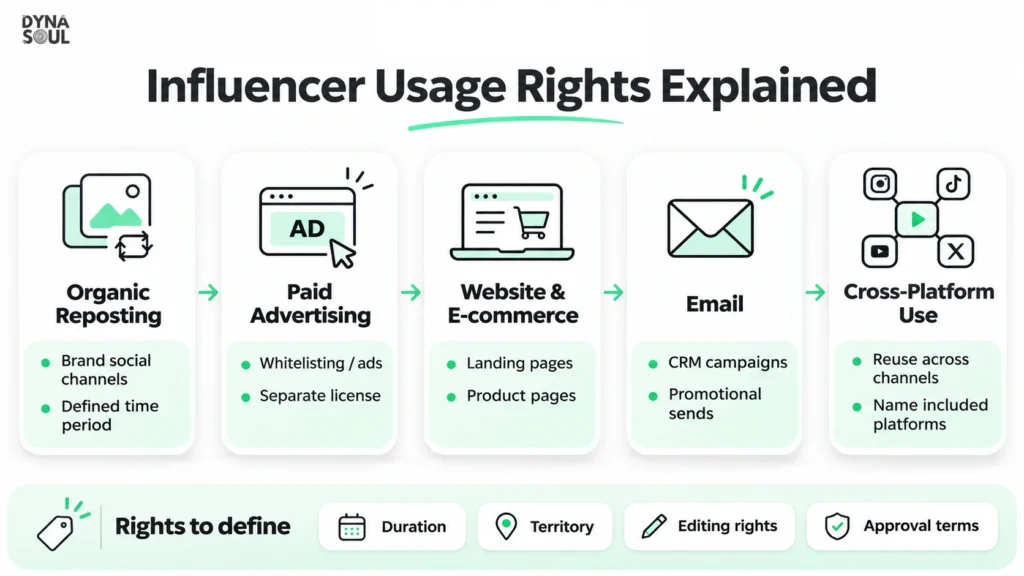
Usage rights define what the brand is allowed to do with creator content after it has been produced. They are one of the most important variables in influencer marketing costs because the base sponsorship fee does not automatically give the brand unlimited permission to reuse the content everywhere.
A contract should clearly distinguish between the creator publishing content on their own account and the brand obtaining permission to use that content elsewhere.
Organic Reposting Rights
The brand may want to repost the creator’s content on its own social accounts. The agreement should state which channels are included and how long the brand can continue using the content.
Paid Advertising Rights
If the brand wants to use creator content in paid advertising, that should be negotiated explicitly. Paid use can expose the creator’s image, voice, and content to a much larger audience than the original organic post, so creators may charge additional licensing fees.
Website, E-commerce, and Email Rights
Using creator content on product pages, landing pages, marketplaces, email campaigns, or other owned channels may require separate permission depending on the contract.
Cross-Platform Rights
A video created for one social platform should not automatically be assumed to be licensed for every other platform. If the brand wants broad reuse, the agreement should name the included channels.
Duration and Territory
Rights should have a defined time period and, where relevant, geographic territory. A three-month social license and an indefinite worldwide advertising license represent very different levels of commercial use.
Editing and Derivative Rights
Brands may also want permission to crop, subtitle, shorten, translate, combine, or otherwise adapt creator content. These rights should be discussed rather than assumed.
Platform Ad Authorization Is Not the Same as Contractual Usage Rights
Social platforms can provide technical tools that allow brands to amplify creator content, but activating a platform tool does not replace the need for a clear commercial agreement.
For example, TikTok’s current commercial-content tools allow creators to tag brand partners and authorize content for advertising. The technical authorization period and the contractual license between the creator and brand should still be aligned.
Brands should therefore confirm both the platform setup and the underlying contractual rights before putting creator content into paid media.
Exclusivity Can Add Significant Cost
Exclusivity prevents a creator from working with specified competitors or categories for an agreed period. Because this can remove other earning opportunities, it can increase the creator’s fee.
The broader and longer the restriction, the more valuable it may be to the creator.
A practical exclusivity clause should define:
- The competitors or category covered
- The platforms included
- The start and end date
- Whether existing partnerships are excluded
- Whether the restriction applies only to sponsored content or to all mentions
A narrow, clearly defined restriction can be more efficient than asking for a broad category ban that the campaign does not genuinely need.
Paid Amplification Is a Separate Budget
Brands increasingly use creator content beyond organic distribution by putting paid media behind strong-performing assets. The advertising budget used to amplify that content should normally be separated from the creator fee and usage-rights fee.
This creates three distinct cost layers:
- The creator is paid to produce or publish the content.
- The brand secures the rights or authorization needed for paid use.
- The brand allocates advertising spend to distribute the content.
Separating these costs makes it easier to understand whether the campaign is expensive because of creator compensation, licensing, or the amount of media investment.
Other Campaign Costs Brands Often Miss
Creator Management or Talent Representation
Some creators work through managers or talent agencies. Representation can affect the negotiation process, payment structure, and final commercial package.
Product and Shipping
Physical products may need to be sampled, shipped internationally, replaced, customized, or delivered on a deadline. For global campaigns, logistics can become a meaningful budget line.
Travel and Production
Campaigns involving events, hotels, flights, specialist locations, or production crews can create substantial non-creator costs.
Campaign Management
Creator discovery, outreach, negotiation, contracts, briefing, product coordination, content review, payment, and reporting require time. Brands should account for internal team costs or external agency fees rather than treating campaign management as free.
Affiliate Commissions
If creators receive commission on attributed sales, the brand should forecast that variable cost separately from guaranteed creator fees.
Measurement and Technology
Influencer platforms, affiliate systems, social-listening tools, link tracking, payment systems, and reporting software can add recurring or campaign-specific costs.
How to Build an Influencer Campaign Budget
A practical campaign budget should begin with the objective and work backward into the resources needed to achieve it.
One useful planning sequence is:
Objective → creator mix → deliverables → usage rights → exclusivity → amplification → operations → measurement → total budget
1. Define What the Campaign Must Achieve
An awareness campaign, content-production program, affiliate campaign, product launch, and paid-social creative program may require very different budget structures.
2. Decide the Creator Mix
Determine whether the objective is better served by several focused creators, a smaller number of larger creators, specialist voices, long-term ambassadors, or a mixed portfolio.
3. Define Deliverables Before Requesting Rates
Ask creators to quote against a specific scope. A vague request for “your rate” can produce quotes that are difficult to compare because each creator may assume a different package.
4. Decide How the Content Will Be Used
If paid advertising, website use, marketplace use, email, or cross-platform reuse is planned, negotiate those rights from the beginning rather than adding them after the content has already been created.
5. Define Exclusivity Carefully
Only request the restriction the brand actually needs. Unnecessarily broad exclusivity can increase cost without creating equivalent value.
6. Reserve Budget for Amplification
If the strategy includes paid support behind creator content, keep the media budget visible as a separate line item.
7. Include Management and Measurement
Budget for the work required to operate the campaign and evaluate results. A creator program can become difficult to scale when the brand funds content but not the infrastructure required to manage it.
How to Compare Creator Quotes Fairly
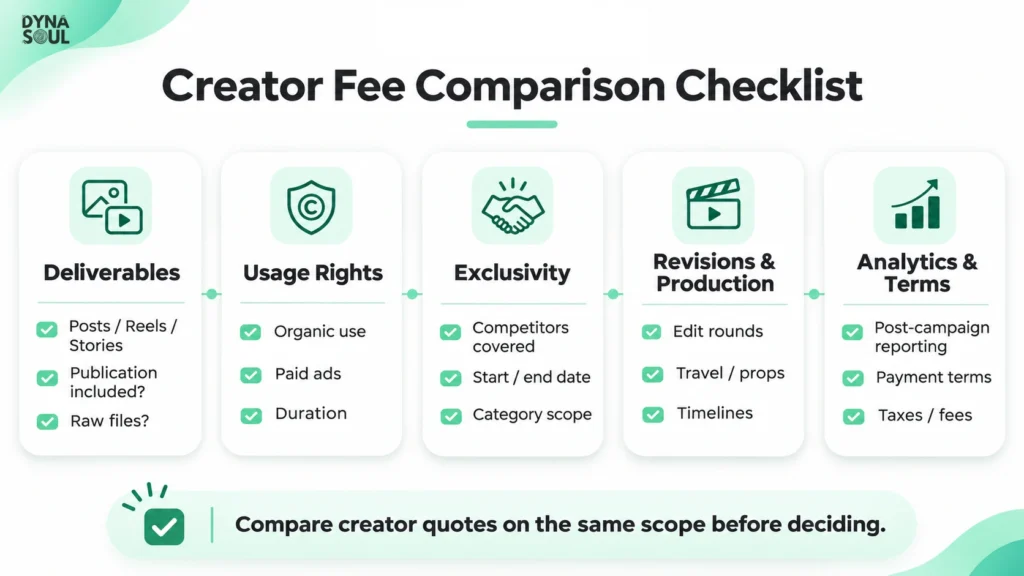
Two quotes should only be compared after the scope has been normalized.
Before deciding that one creator is cheaper, check:
- How many deliverables are included?
- Which platforms are included?
- Is publication included or only content production?
- How many revisions are included?
- Are raw files provided?
- What usage rights are included?
- Is paid advertising allowed?
- How long do the rights last?
- Is exclusivity included?
- Is travel or specialist production required?
- Are management fees or taxes included?
- Does the creator provide post-campaign analytics?
A higher quote may provide better value if it includes broader rights, more useful assets, stronger audience fit, or a more comprehensive package.
How to Evaluate Whether a Creator Fee Is Worth It
A fair rate is not necessarily the lowest possible rate. The better question is whether the expected value justifies the total cost and whether the campaign can generate useful learning.
Depending on the objective, brands can evaluate:
- Expected relevant reach
- Cost per usable content asset
- Engagement quality
- Traffic and conversion potential
- Affiliate or attributed revenue
- New-customer acquisition
- The value of licensed content for paid media
- The creator’s strategic fit for a longer-term partnership
For conversion-focused activity, compare the total campaign cost with the value of the resulting customers or sales. For awareness or content campaigns, avoid forcing every outcome into a direct revenue calculation when the campaign was not designed that way.
Common Influencer Marketing Cost Mistakes
Using Follower Count as the Pricing Formula
Follower count does not capture audience relevance, actual reach, content quality, creator demand, production effort, usage rights, or exclusivity.
Assuming the Base Fee Includes Unlimited Usage
A sponsored post and a long-term advertising license are different commercial products. Rights should be negotiated explicitly.
Adding Usage Rights After the Content Is Produced
Late negotiations can create delays or unexpected costs. Decide how the brand expects to use the content before contracting the creator whenever possible.
Requesting Broad Exclusivity Without a Business Reason
Restricting a creator from a large category for a long period can increase fees because the creator may lose other sponsorship opportunities.
Ignoring Campaign Management Costs
Managing dozens of creator relationships can require substantial operational work even when individual creator fees are modest.
Confusing Creator Fees With the Total Campaign Budget
The total cost can include licensing, media spend, commissions, product, shipping, technology, production, and management in addition to the creator’s base payment.
FAQ
How much does influencer marketing cost?
There is no universal price. Influencer marketing costs depend on the creator, platform, audience, content format, number of deliverables, production requirements, usage rights, exclusivity, paid amplification, and campaign-management needs. Brands should compare the full commercial package rather than follower count alone.
How much should a brand pay an influencer?
A reasonable fee depends on what the creator is being asked to deliver and the value of their audience, content, and commercial rights. Current benchmark ranges can help with early planning, but the final quote should be evaluated against recent performance, audience fit, production effort, licensing, and campaign objectives.
Are usage rights included in an influencer’s fee?
Not automatically. Some agreements include limited usage, while others price licensing separately. Brands should define where the content can be used, whether paid advertising is permitted, how long the rights last, which territories are covered, and whether the content can be edited.
Why do influencers charge extra for paid usage?
Paid advertising can expose creator content and likeness to a much larger audience and extend the commercial life of the asset beyond the original organic post. Creators may therefore treat paid usage as a separate license with additional value.
Does exclusivity increase influencer marketing costs?
It can. Exclusivity may prevent a creator from accepting other sponsorships during the restricted period. Longer durations, broader competitor definitions, and wider category restrictions can increase the commercial value of the restriction.
What should an influencer campaign budget include?
A complete campaign budget can include creator fees, usage rights, exclusivity, paid amplification, product and shipping, production, management, affiliate commissions, technology, and measurement. The exact mix depends on the campaign objective and what the brand manages internally.
Final Thoughts on Influencer Marketing Costs
Influencer marketing costs become much easier to evaluate when brands stop treating the creator’s headline fee as the entire campaign budget. The real cost depends on what is being produced, who will see it, where the content can be used, how long the rights last, whether competitors are restricted, and how much operational and paid-media support the campaign needs.
The most useful budgeting process starts with the objective, defines the deliverables and rights clearly, and then compares creator quotes on the same commercial basis. That gives brands a better way to judge value than follower count or a generic cost-per-post benchmark.
If your brand needs support planning creator partnerships, campaign budgets, content rights, and influencer execution, explore Dyna Soul Solutions.


